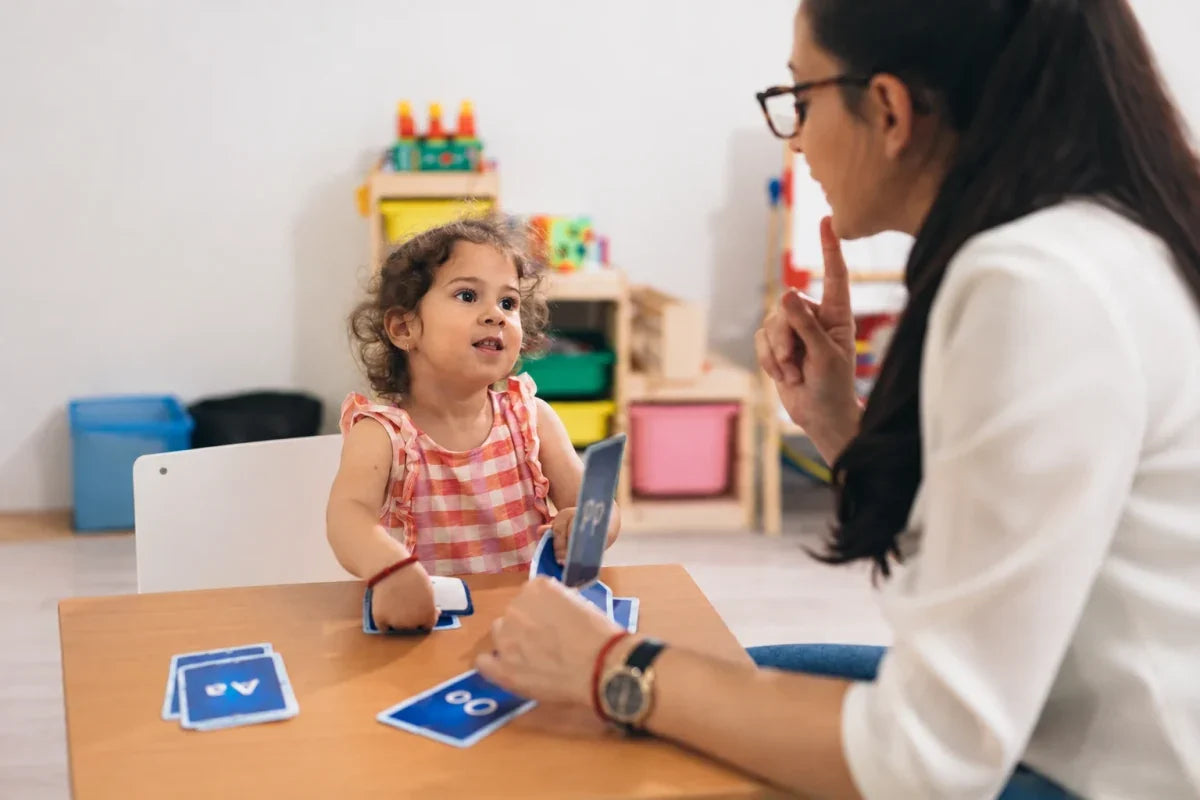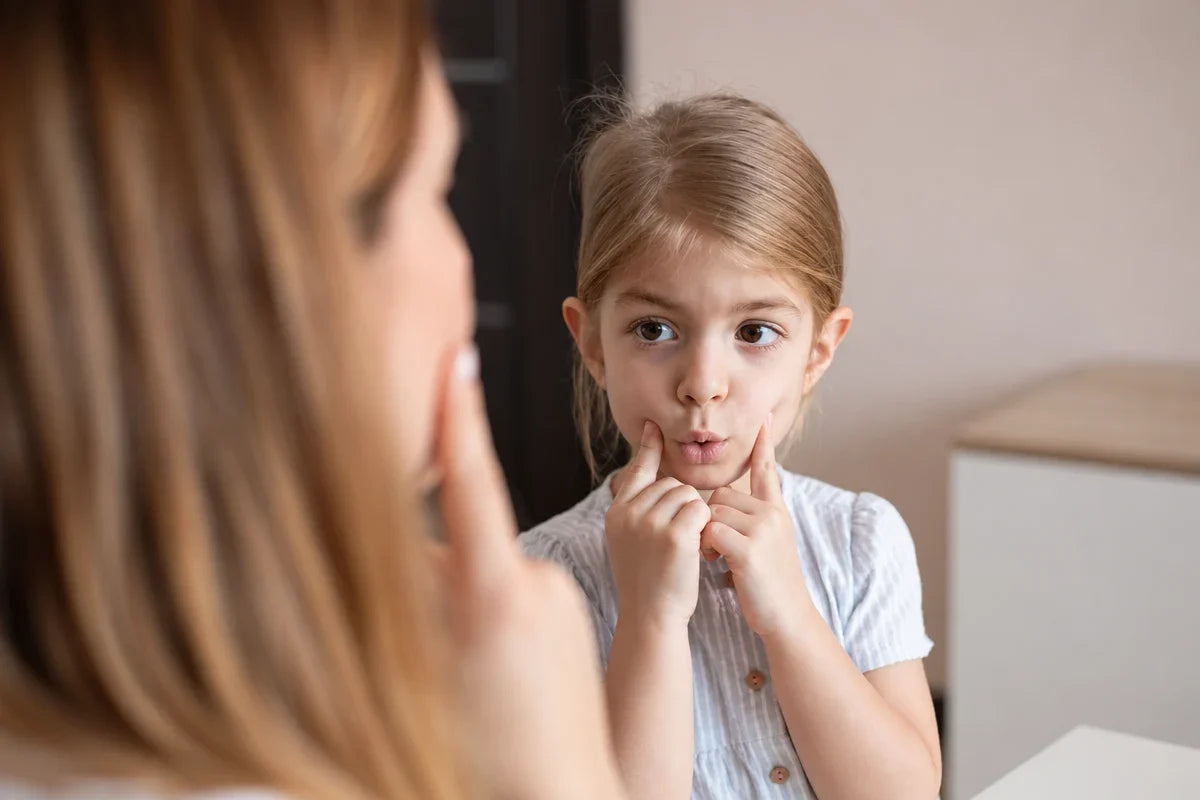
Childhood apraxia of speech (CAS) is a speech sound disorder in which a child’s brain has trouble planning the movements for speech (Chenausky & Tager-Flusberg, 2022). Your child knows what they want to say, but CAS can make it much harder to get their lips, tongue, and jaw to move in the right order, at the right time.
It’s completely normal to feel a little overwhelmed if apraxia came up at your child’s last appointment. CAS is an area we’re passionate about at Bjorem Publications. With the speech apraxia definition in hand, you can start looking for exactly the right kind of help.
What the CAS Definition Means in Everyday Terms
Let’s use the word “banana” as an example. To say it, your child closes their lips, opens their jaw, moves their tongue, and glides from “ba” to “na” to “na,” all in a split second.
With CAS, your child’s muscles can make each of those movements. The challenge is the plan their brain sends to those muscles, telling them which movement comes next (Chenausky & Tager-Flusberg, 2022). Putting the steps in order is so tricky for their brains that the same word can come out clearly once and sound different the next time (Iuzzini-Seigel, Hogan, & Green, 2017).
Many children with CAS understand language much better than they can use it, so your child can usually understand you even when their own words are hard for others to understand.
However, there are still some children with CAS who find understanding language hard (Chenausky et al., 2023). That’s why we always recommend asking your SLP to check how well your child understands words, as well as how they say them.

How CAS Differs From Dysarthria and a Speech Delay
Dysarthria affects how the body performs speech movements, while CAS affects how the brain plans them (Chenausky & Tager-Flusberg, 2022). Some children have both (Iuzzini-Seigel, Allison, & Stoeckel, 2022), and a speech-language pathologist (SLP) can tell you which one is behind your child’s speech errors.
A speech delay is when a child learns speech sounds in the usual order, just more slowly than other kids their age. A child with CAS makes different kinds of errors. Inconsistent errors (like the “banana” that comes out differently each time) are one of the ways SLPs tell CAS and a speech delay apart (Iuzzini-Seigel et al., 2017).
Apraxia can also affect adults after a stroke, but CAS is the type of apraxia that shows up in childhood, as kids learn to talk.
The Signs SLPs Listen For
SLPs look for a group of signs together, starting with the core features researchers have started to agree on:
- Inconsistent errors: A syllable or word changes from one try to the next.
- Choppy transitions: Coarticulation (the way the mouth glides from one sound into the next) is slow or disrupted, so words can sound stretched out. Some kids also pause between sounds, syllables, or words, so “butterfly” can come out as “but... ter... fly” (Murray, McCabe, Heard, & Ballard, 2015).
- Unusual prosody: Prosody (the rhythm, pitch, and stress of speech) sounds off, especially which part of a word gets the stress (Murray et al., 2015).
To help kids understand what their voice is doing, we made Prosody Cues, physical picture cards for pitch, volume, rate, stress, rhythm, and emotions. During practice, your child can look at a card to see the change in their voice they’re aiming for.

How an SLP Makes the Diagnosis
Diagnosing CAS comes down to an SLP listening closely to your child’s speech and using their expert judgment (Murray et al., 2015). Researchers are still working on tests that can tell CAS apart from other speech sound disorders reliably (Murray et al., 2021).
Expert judgment comes with experience, and CAS is rare, affecting about 1 in 1,000 children aged 4 to 8 (Shriberg, Kwiatkowski, & Mabie, 2019). That’s why we recommend finding an SLP with CAS experience. It’s also why our founder, Jennie Bjorem, M.A., CCC-SLP, travels the world teaching SLPs how to assess, diagnose, and treat CAS.
If you’re an SLP and you suspect CAS in a child on your caseload, you can start with an apraxia screener so your evaluation has a clear structure from the first session. You’ll find an informal CAS assessment, a stimulus picture book, a speech and language sample, and an evaluation report template in the CAS Assessment & Screening Toolkit, all in one digital download. Jennie based the report template on hundreds of her own apraxia evaluations.

What the Definition Means for Your Child’s Next Steps
Researchers have only recently started to learn what causes CAS, and many children still don’t have an identified cause (Morgan et al., 2024). The good news is that your child can start therapy without that answer.
At least three CAS treatments have enough research behind them for SLPs to use in therapy (Murray, McCabe, & Ballard, 2014), so your child’s SLP can pick the apraxia treatment that fits your child best. It also helps to think about how often your child goes. In one study, children with CAS who had therapy twice a week made more progress in articulation (how clearly they make sounds) and everyday communication than children who went once a week (Namasivayam et al., 2015).
During and between sessions, SLPs and families use apraxia cards for picture-based practice with sound sequences. We field-test our tools in therapy with kids, so they stand up to plenty of repetition. Every one of these steps starts with an evaluation, so if any of this sounds like your child, don’t wait - evaluate.
Frequently asked questions
Can a child have CAS and a language disorder at the same time?
They can, and it’s very common. In a review of 375 children’s records, over 93% of children with CAS also had an expressive language impairment, which means trouble putting thoughts into words and sentences (Chenausky et al., 2023; Erratum, 2023).
My child says short words clearly but struggles with longer ones. Can that still be CAS?
It can. Children with CAS often make more errors on longer words, and SLPs use long-word naming tasks to help spot it (Murray et al., 2015). Tell your SLP that short words come out clearly but longer ones are harder, so they can test your child on both.
Is my toddler too young for a CAS evaluation?
Not at all, but a diagnosis may need to wait. Differences in early vocal sounds can show up before age 3 in children later diagnosed with CAS (Overby & Caspari, 2015). Clinicians still disagree about diagnosing CAS this young (Valentine, Keller, Harel, & Grigos, 2026), and we recommend caution until your child is ready for a full motor speech assessment. The good news is your child doesn’t need a diagnosis to get started. If your SLP suspects apraxia, they can use a motor-based approach right away and keep watching how your child’s speech develops. Book an evaluation as soon as you have a concern.
What can we bring to an SLP evaluation to help?
Bring short videos or notes of your child saying the same word on different days and in different places, like at home and at the park. With CAS, the same word often changes from try to try (Iuzzini-Seigel et al., 2017), so your SLP can hear how your child’s words change over time.
Sources:
- Chenausky, K. V., Baas, B., Stoeckel, R., Brown, T., Green, J. R., Runke, C., Schimmenti, L., & Clark, H. (2023). Comorbidity and severity in childhood apraxia of speech: A retrospective chart review. Journal of Speech, Language, and Hearing Research, 66(3), 791 to 803. https://doi.org/10.1044/2022_JSLHR-22-00436
- Chenausky, K. V., Baas, B., Stoeckel, R., Brown, T., Green, J. R., Runke, C., Schimmenti, L., & Clark, H. (2023). Erratum to “Comorbidity and severity in childhood apraxia of speech: A retrospective chart review.” Journal of Speech, Language, and Hearing Research, 66(11), 4461 to 4463. https://doi.org/10.1044/2023_JSLHR-23-00384
- Chenausky, K. V., & Tager-Flusberg, H. (2022). The importance of deep speech phenotyping for neurodevelopmental and genetic disorders: A conceptual review. Journal of Neurodevelopmental Disorders, 14(1), Article 36. https://doi.org/10.1186/s11689-022-09443-z
- Iuzzini-Seigel, J., Allison, K. M., & Stoeckel, R. (2022). A tool for differential diagnosis of childhood apraxia of speech and dysarthria in children: A tutorial. Language, Speech, and Hearing Services in Schools, 53(4), 926 to 946. https://doi.org/10.1044/2022_LSHSS-21-00164
- Iuzzini-Seigel, J., Hogan, T. P., & Green, J. R. (2017). Speech inconsistency in children with childhood apraxia of speech, language impairment, and speech delay: Depends on the stimuli. Journal of Speech, Language, and Hearing Research, 60(5), 1194 to 1210. https://doi.org/10.1044/2016_JSLHR-S-15-0184
- Morgan, A. T., Amor, D. J., St John, M. D., Scheffer, I. E., & Hildebrand, M. S. (2024). Genetic architecture of childhood speech disorder: A review. Molecular Psychiatry, 29(5), 1281 to 1292. https://doi.org/10.1038/s41380-024-02409-8
- Murray, E., Iuzzini-Seigel, J., Maas, E., Terband, H., & Ballard, K. J. (2021). Differential diagnosis of childhood apraxia of speech compared to other speech sound disorders: A systematic review. American Journal of Speech-Language Pathology, 30(1), 279 to 300. https://doi.org/10.1044/2020_AJSLP-20-00063
- Murray, E., McCabe, P., & Ballard, K. J. (2014). A systematic review of treatment outcomes for children with childhood apraxia of speech. American Journal of Speech-Language Pathology, 23(3), 486 to 504. https://doi.org/10.1044/2014_AJSLP-13-0035
- Murray, E., McCabe, P., Heard, R., & Ballard, K. J. (2015). Differential diagnosis of children with suspected childhood apraxia of speech. Journal of Speech, Language, and Hearing Research, 58(1), 43 to 60. https://doi.org/10.1044/2014_JSLHR-S-12-0358
- Namasivayam, A. K., Pukonen, M., Goshulak, D., Hard, J., Rudzicz, F., Rietveld, T., Maassen, B., Kroll, R., & van Lieshout, P. (2015). Treatment intensity and childhood apraxia of speech. International Journal of Language & Communication Disorders, 50(4), 529 to 546. https://doi.org/10.1111/1460-6984.12154
- Overby, M., & Caspari, S. S. (2015). Volubility, consonant, and syllable characteristics in infants and toddlers later diagnosed with childhood apraxia of speech: A pilot study. Journal of Communication Disorders, 55, 44 to 62. https://doi.org/10.1016/j.jcomdis.2015.04.001
- Shriberg, L. D., Kwiatkowski, J., & Mabie, H. L. (2019). Estimates of the prevalence of motor speech disorders in children with idiopathic speech delay. Clinical Linguistics & Phonetics, 33(8), 679 to 706. https://doi.org/10.1080/02699206.2019.1595731
- Valentine, H. C., Keller, S., Harel, D., & Grigos, M. I. (2026). Clinicians’ perspectives on diagnosing and treating childhood apraxia of speech in children under 3 years old. American Journal of Speech-Language Pathology, 35(1), 266 to 283. https://doi.org/10.1044/2025_AJSLP-25-00215