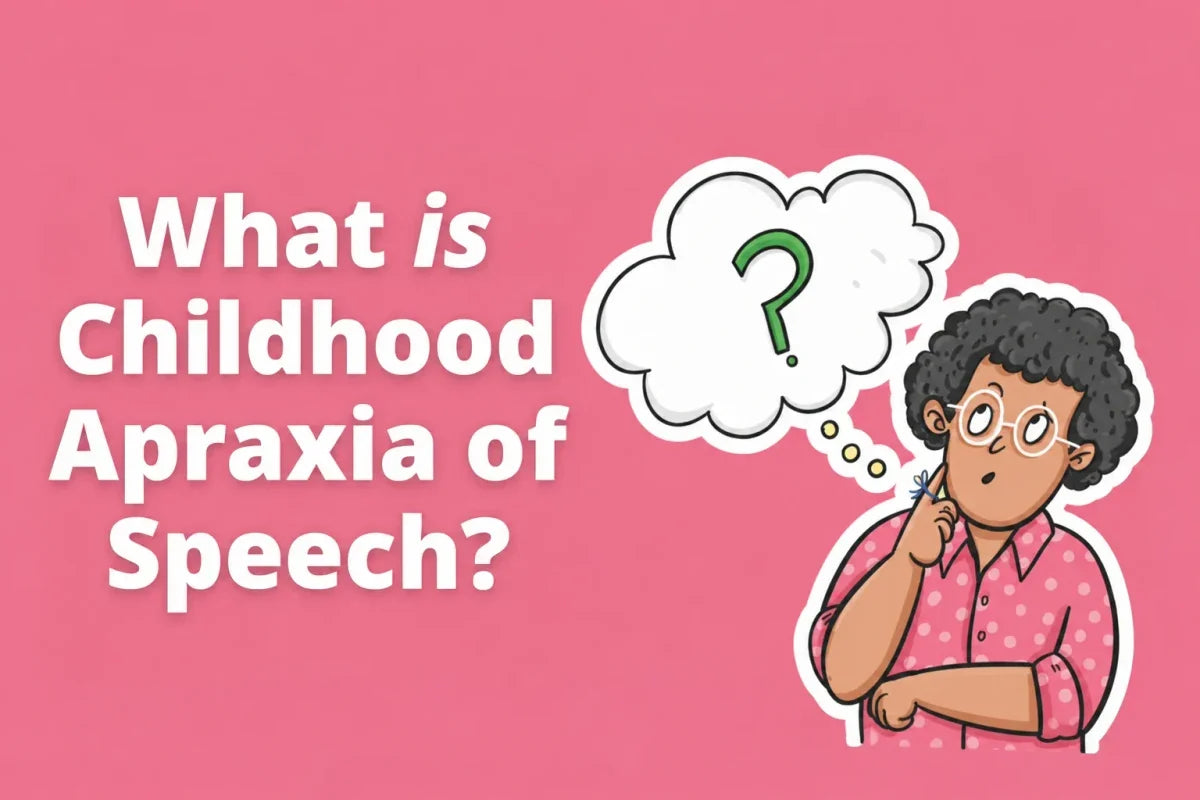

There’s no single answer to what causes apraxia in children. For about 1 in 3 children with childhood apraxia of speech (CAS, trouble planning the movements for speech), a change in one gene (one of the body’s instruction codes) is the cause (Morgan et al., 2024). Other children develop CAS after something affects their brain early in life, and for many, the cause is still unknown.
If you’re asking yourself whether something you did caused your child’s CAS, please let that worry go. Nothing about your parenting causes CAS, and in many children it’s present from birth.
What Can Cause CAS?
We find it helps to think about the possible causes in four groups. Every child is different, so some might fit into one group, while others might fit into more.
- A gene change that mainly affects speech: Sometimes a change in a single gene causes CAS, with few other difficulties (Morgan & Webster, 2018). FOXP2 (a gene that’s active in the parts of the brain used for speech and language) was the first gene found to do this (Morgan et al., 2024).
- A wider condition that affects brain development: Sometimes CAS is one of several signs of a bigger condition that affects how the brain develops, like epilepsy (a condition that causes seizures) or fragile X syndrome (a genetic condition that affects learning). In these children, CAS is part of the wider condition rather than a separate problem. That’s one reason rates of CAS are higher in children with some of these conditions.
- Something that affected the brain early on: A stroke (blocked blood flow in the brain) before or soon after birth, an infection, an injury, or surgery to remove a brain tumor can also lead to CAS. It’s still called CAS, because the name covers any apraxia of speech that starts in childhood, whatever the cause.
- No known cause yet: For many children, no concrete cause has been found yet, but new genes and other causes linked to CAS are still being discovered (Morgan et al., 2024).

How Genes Can Cause CAS
More than 30 genes have now been linked to CAS, with names like FOXP2, CDK13, EBF3, and SETBP1 (Morgan et al., 2024). Don’t worry about the letters and numbers! They’re just the short codes scientists use to name each gene.
Many of these genes work like switches. Your body has thousands of genes, and not every gene is needed in every part of the body all the time. Switch genes turn other genes on and off, so each part of the brain develops the way it should at the right time. When a child has a change in one of these switch genes, other genes don’t get switched on and off the way they normally would. As a result, the brain’s speech pathways can form differently before birth (Morgan et al., 2024).
What we find reassuring for families, though, is that most of the gene changes found so far are brand-new in the child, rather than passed down from a parent. In one study, 15 of 18 gene changes were new (Kaspi et al., 2023). However, some other gene changes do run in families, which could explain why many families of children with CAS have relatives with speech difficulties (Morgan et al., 2024).
Why the Cause of CAS Can Be Tough to Find
If your child’s doctors haven’t found a cause, lots of families are in the same spot. It's not a failing on you or your provider's part. We know how frustrating the wait for answers can be. Finding the cause of CAS is tricky for a few reasons:
- Brain scans look typical: A standard brain scan of a child with CAS doesn’t show anything unusual (Morgan & Webster, 2018), so doctors can’t spot the cause on a scan.
- Each gene is rare: Most of the genes linked to CAS have only been found in one or a few children so far (Morgan et al., 2024), so labs have a long list of genes to test for.
- Tests can’t detect every change: Today’s genetic tests can’t pick up every kind of gene change, so a test can come back clear even when a gene change is involved.
- The research is still young: FOXP2 was found in 2001, and most of the other CAS genes have been found in just the last few years (Morgan et al., 2024).
We’re hopeful that more families will get answers as scientists find more genes linked to CAS.

Should Your Child Have Genetic Testing?
We recommend asking your child’s doctor about genetic testing, since testing is now part of the advice for children with CAS (Morgan et al., 2024). We know it can sound a bit scary, but if a test finds the gene change behind your child’s CAS, your family can:
- Feel some relief: You’ll have an answer to the “why” question, and many families find that a relief.
- Plan the right check-ups: Many of the genes linked to CAS can also affect learning or cause seizures (Morgan et al., 2024), so your child’s doctors will know what to keep an eye on.
- Share the result with relatives: Since some gene changes are passed down, the result can be useful for other relatives, like your child’s aunts and uncles.
- Plan your family: If you’re thinking about having more children, you can use the result when you’re deciding.
Testing is an especially good idea if your child also has other challenges, like learning to walk late or trouble understanding words. Children with a motor speech disorder (trouble planning or controlling speech movements) like CAS who also have these kinds of challenges are more likely to have a genetic cause (Van Niel et al., 2026). If you’re a speech-language pathologist (SLP), note these challenges in your report, so the family’s doctor can decide about testing.
Your child’s doctor can refer you to a genetics team, who will choose the right test. If the test doesn’t find a gene change, your child still has CAS. A genetic counselor (a specialist in genetic testing and family health) can go over the results with you, whatever they show.

What to Share With Your Child’s SLP and Doctor
You know your child’s story better than anyone. With the details you share, your child’s SLP and doctor can work out what’s behind their CAS, so we suggest jotting these down before your next appointment:
- Anything that happened during pregnancy or birth
- Illnesses or injuries in your child’s early years
- Family members who had speech or learning difficulties
- Any genetic test results
- Reports from earlier speech evaluations
Earlier speech reports are one of the most valuable things you can bring. Our collaborator Breanna Waldrup, M.S., CCC-SLP, a CAS specialist, is almost never the first SLP a child has seen when she evaluates them for CAS, so there’s often a report or two already.
If your child has a related diagnosis, it can also change what to expect as your child grows, so let everyone on your child’s team know about it. And if your child hasn’t had an evaluation yet, don’t wait - evaluate. It’s the first step toward finding a cause, since doctors look for a genetic cause once CAS is confirmed (Morgan & Webster, 2018).
Whatever the cause turns out to be, your child learns new speech movements through lots of practice. With apraxia toys like mini objects, you can turn that practice into play at home.
Frequently asked questions
Will my other children have CAS too?
Not necessarily, but we recommend keeping an eye on a younger sibling’s speech and asking for an evaluation early if anything concerns you, so they can get support straight away if they need it.
Could my child pass CAS on to their own kids one day?
It depends on the cause. If testing finds a gene change, a genetic counselor can explain the chances of passing it on. If the cause isn’t known, a counselor can still go over your family’s history with you.
Will a genetic test result change my child’s speech therapy?
Not right now. Your SLP plans therapy around how your child speaks, but gene findings could lead to more targeted therapies in the future (Morgan et al., 2024).
Can CAS be prevented?
Not yet. Since the cause is still unknown for many children, there’s no known way to prevent CAS. What you can do is get your child evaluated as soon as you notice a concern, so support can start early.
Sources:
- Kaspi, A., Hildebrand, M. S., Jackson, V. E., Braden, R., van Reyk, O., Howell, T., Debono, S., Lauretta, M., Morison, L., Coleman, M. J., Webster, R., Coman, D., Goel, H., Wallis, M., Dabscheck, G., Downie, L., Baker, E. K., Parry-Fielder, B., Ballard, K., . . . Morgan, A. T. (2023). Genetic aetiologies for childhood speech disorder: Novel pathways co-expressed during brain development. Molecular Psychiatry, 28(4), 1647 to 1663. https://doi.org/10.1038/s41380-022-01764-8
- Morgan, A. T., Amor, D. J., St John, M. D., Scheffer, I. E., & Hildebrand, M. S. (2024). Genetic architecture of childhood speech disorder: A review. Molecular Psychiatry, 29(5), 1281 to 1292. https://doi.org/10.1038/s41380-024-02409-8
- Morgan, A. T., & Webster, R. (2018). Aetiology of childhood apraxia of speech: A clinical practice update for paediatricians. Journal of Paediatrics and Child Health, 54(10), 1090 to 1095. https://doi.org/10.1111/jpc.14150
- Van Niel, H., Lauretta, M., Baker, E., O’Donnell, L., Boulton, C., Brenchley, C., Coman, D., Michellis, E., Goel, H., Thompson, G., Webster, R., Paxton, G., Stark, Z., Scheffer, I. E., Hildebrand, M. S., Amor, D. J., & Morgan, A. T. (2026). Childhood motor speech disorders: Who to prioritise for genetic testing. European Journal of Human Genetics, 34(5), 639 to 648. https://doi.org/10.1038/s41431-025-01993-9