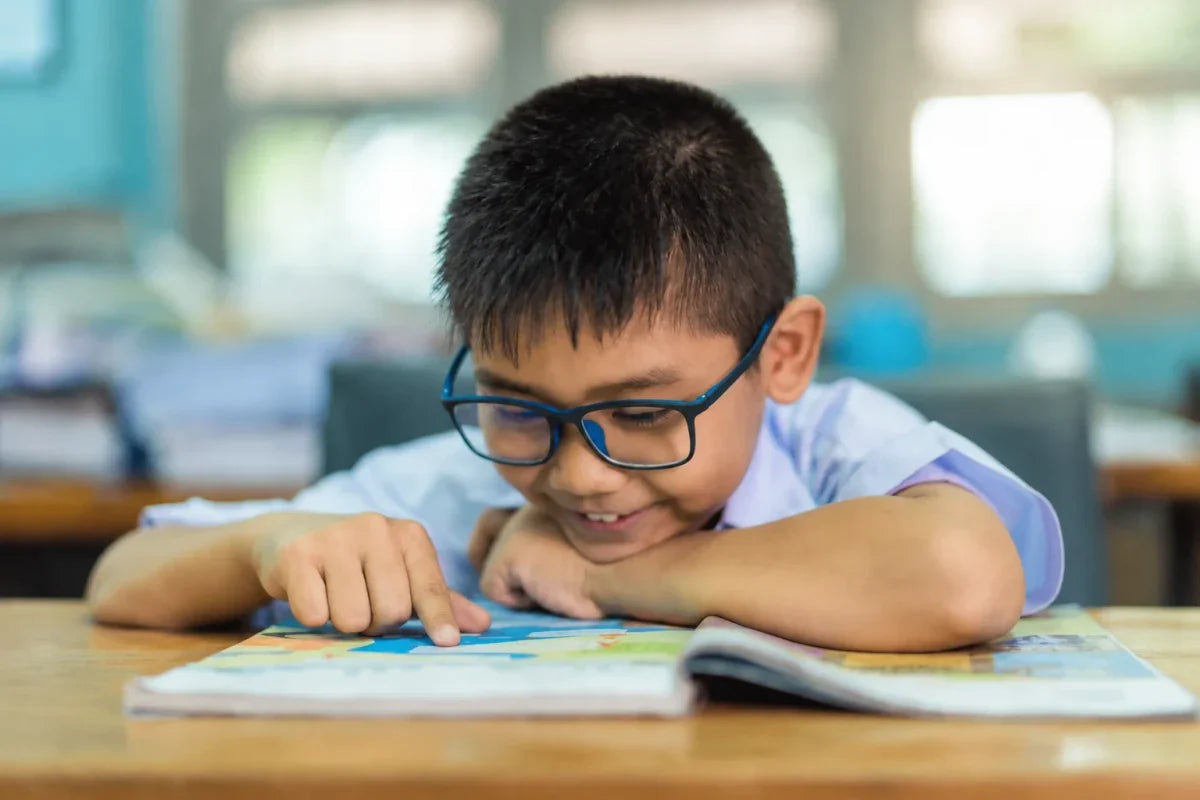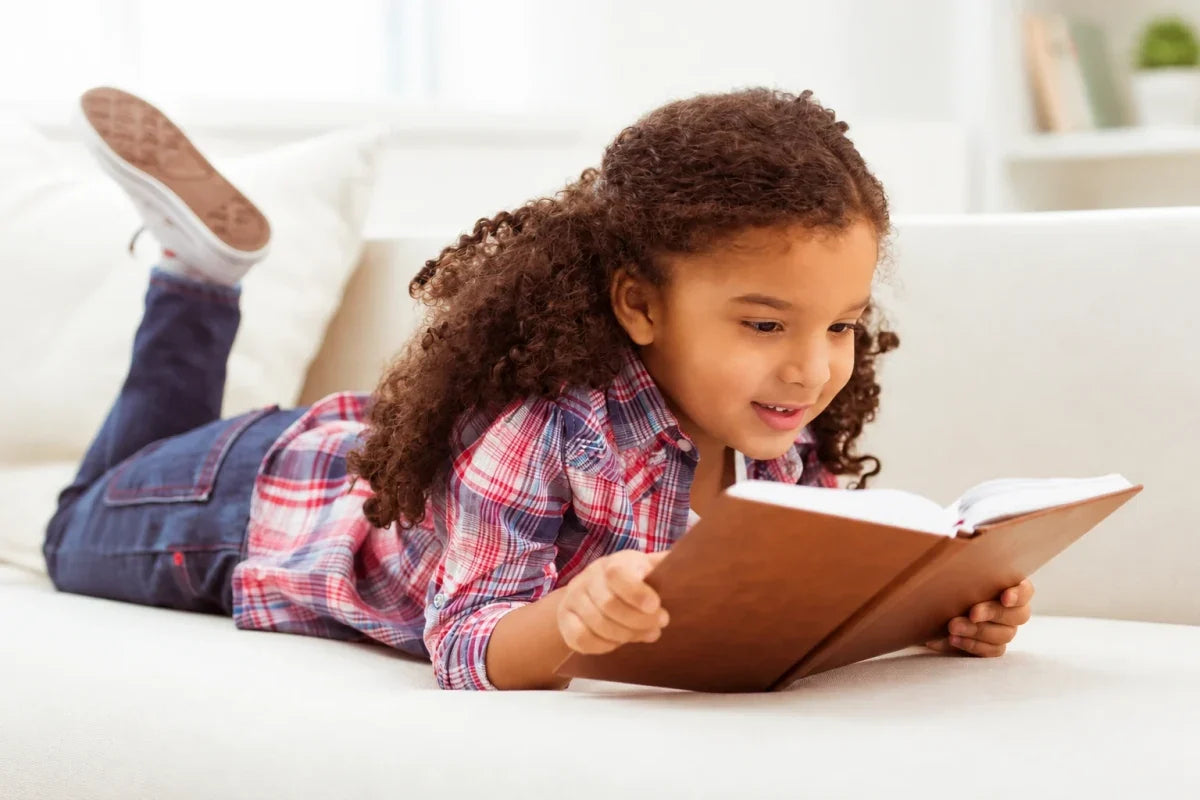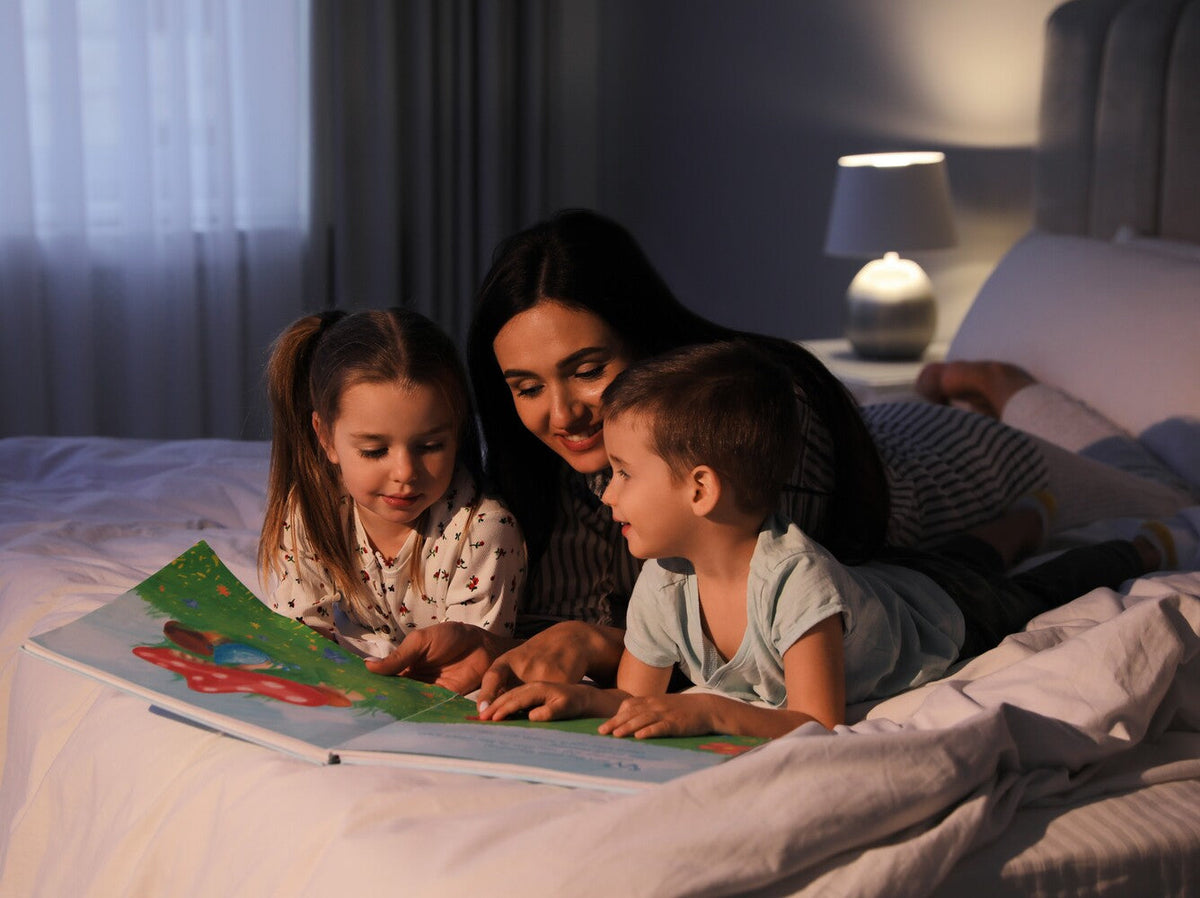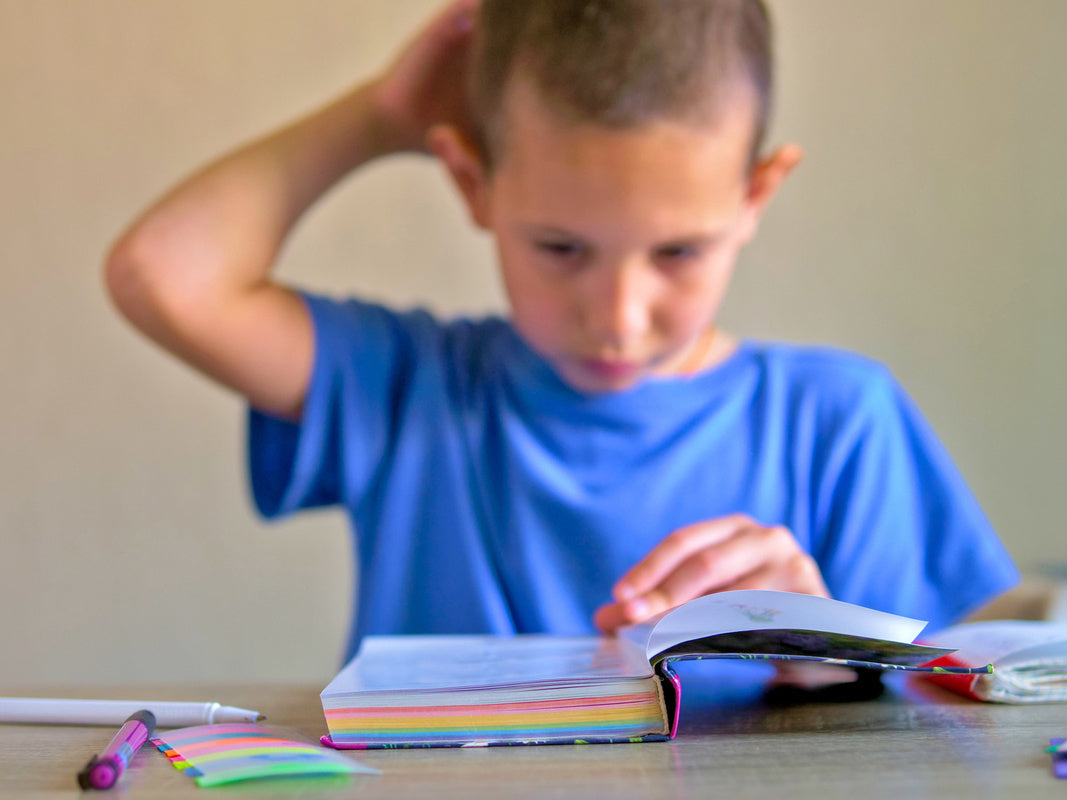
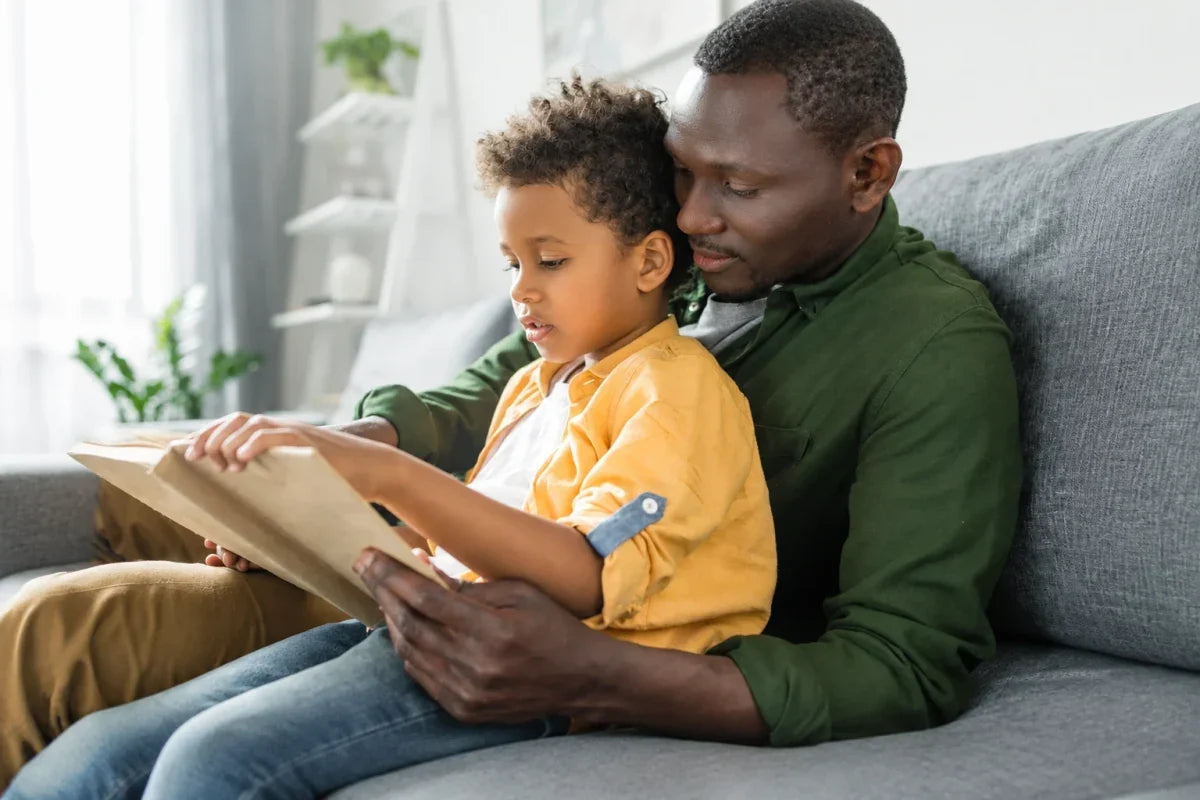
When you read with your child, they hear new words and learn how other people feel, all while sitting close to you. Studies of the effects of reading on child development have found gains in vocabulary and emotional understanding.
So what does that mean for you as a parent?
Mostly, it means that how you read (Mol et al., 2008) and how much you read have an impact for different reasons (Mol & Bus, 2011). Children get the most from story time when you stop to talk about the pictures, explain a word they haven’t heard, and ask what your child thinks happens next.
At Bjorem Literacy, we see how much of a child’s language comes from the time an adult spends talking with them, and story time is where a lot of that happens.
How Reading Affects Your Child’s Vocabulary and Language Development
You’ll find words in picture books that almost never come up at home, like “enormous,” “whispered,” and “meadow” (Montag, Jones, & Smith, 2015). Your child hears one of those words with a picture in front of them and a story around it, so they can work out roughly what it means before you explain anything. At the grocery store, you use the same handful of words every week.
Children whose grown-ups chat with them about the book pick up more words and better grammar than children who hear the pages read straight through (Grøver et al., 2020). It’s a modest difference, and you’ll notice it over months rather than overnight.
So when “meadow” turns up at storytime tonight, point at the picture and tell your child what it means in a few plain words. Then keep going with the story.

What Reading Does for Thinking and Memory
Following a story is harder work than it looks. Your child has to hold the whole thing in their head, because the bear who was sad on page two is the same bear who finds his friend on page nine.
Stop and tie what you’ve just read back to something earlier in the book, and your child remembers far more of it (Miller-Goldwater et al., 2024). Children whose parents learn to share books this way also pay better attention (Vally et al., 2015).
Stories are also a good place to practice critical thinking, which means weighing something up instead of taking it at face value. Your child decides whether the bear made a good choice, working the problem through from inside somebody else’s head.
Ask “what would you have done?” and you’ll hear that reasoning out loud. Children with language difficulties who got questions like these made gains in exactly that skill (van Kleeck et al., 2006).
Reading and Your Child’s Phonological Awareness
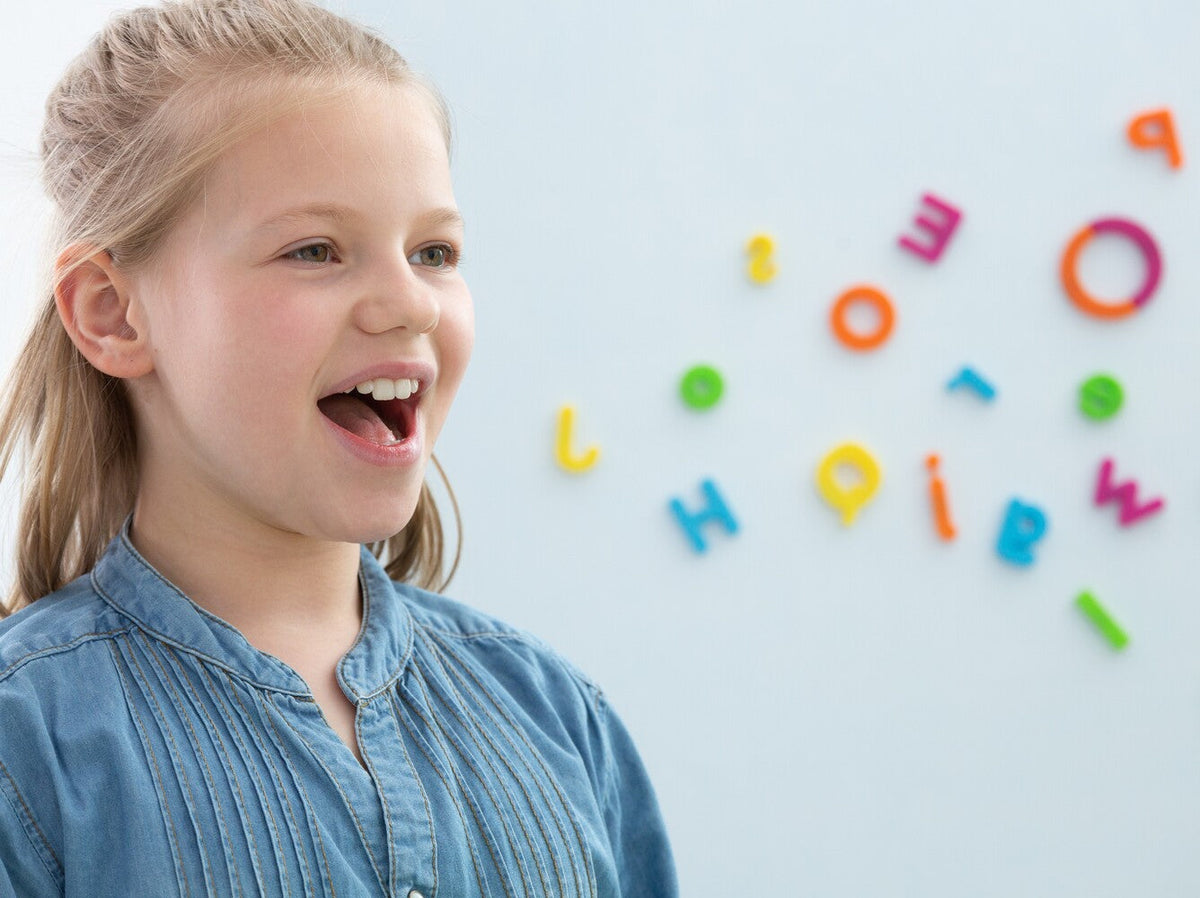
Your child hears “cat” as one lump of sound to start with. Phonological awareness is being able to pull that lump apart and notice the smaller sounds inside it. Your child needs that before they can sound out a word on the page, because sounding out only works if you know what the pieces sound like (Melby-Lervåg, Lyster, & Hulme, 2012).
Reading out loud is how your child starts noticing those pieces. When you read, you slow down and say each word more clearly than you do in conversation, so the sounds inside it are easier to catch. Rhyming books do more still, because “cat,” “hat,” and “mat” put the same ending in front of your child over and over until they hear what the three words share (Bryant, Bradley, MacLean, & Crossland, 1989).
This strengthens your child’s phonological awareness, which can make them stronger, more independent readers later.

How Reading Affects Emotional Growth and Connection
Your child meets feelings in a book before they have words for them at home. The bear is jealous that his friend has a new bike, and jealousy stops being a vague, horrible feeling and becomes a thing with a name and a reason behind it. Children who read or get read to this way also get better at working out how other people feel (Grøver et al., 2020).
A book is also easier to talk about than your child’s own day. You can ask why the bear felt left out and your child can answer freely, because the hard feeling belongs to the bear instead of them. If you keep asking, your child learns that feelings are something that they can discuss out loud with you.

What the Research Shows
Children who get read to, and who go on to read plenty by themselves, end up with bigger vocabularies and stronger comprehension than children who do less of it, and that holds from preschool through to university age (Mol & Bus, 2011). Reading together is one part of your child’s early literacy development. For younger children, being read to at home connects to better language and better reading once school starts (Bus, van IJzendoorn, & Pellegrini, 1995).
What story time doesn’t do is teach your child which letters make which sounds. No amount of listening tells your child that “sh” makes one sound rather than two, so most children need direct lessons in letter sounds and sounding out words alongside the books they love (Ehri, Nunes, Stahl, & Willows, 2001).
Those lessons do the most good when they start in kindergarten and first grade (Ehri et al., 2001). If your child is around that age, we recommend working through structured phonics workbooks at home, so each letter sticks. If your child is younger, keep reading together and leave the letters until they’re ready.
Making Reading Time Work for Your Family
Story time works best when your child wants to be there. Here are four habits that help encourage reading in kids:
- Let your child pick the book, even if it’s the same one for the ninth night in a row. Repetition is actually good because it helps them learn (Horst, Parsons, & Bryan, 2011).
- Say the rhymes out loud and point out first sounds (the sound a word starts with, like the “mmm” in “moon”). This gives them the building blocks for sounding out words on their own (Bryant, Bradley, MacLean, & Crossland, 1989).
- Tie the story back to your child’s week. Asking, “Remember when we saw a duck like that?” connects the new word to something your child already knows (Mol, Bus, de Jong, & Smeets, 2008).
- Stop while your child is still enjoying it. By ending on a good note, you keep your child excited to read again tomorrow.
When to Seek an Evaluation
Reading with your child supports their speech and language, and it’s one of the best things you can do at home. It won’t fix a speech or language difficulty on its own, though.
Have a chat with a speech-language pathologist if your child has fewer than 50 words or no word combinations at two years old (Rescorla, 1989), if people outside your family still struggle to understand them by around age four (Coplan & Gleason, 1988), or if your child can’t hear the difference between similar-sounding words. Any one of those is a sign your child needs speech therapy.
An evaluation doesn’t commit you to anything, and you’ll come away knowing whether what you’re seeing is typical for your child’s age. So, don’t wait - evaluate.
Frequently asked questions
We speak two languages at home. Which language should we read in?
Read in whichever language you speak most comfortably, since your child picks up more from a story you can chat about naturally. Then add books in their school language so the words they’ll see in class are already familiar (Grøver et al., 2020).
Does library story time count, or does it have to be one-on-one?
It counts. Your child just gets less back-and-forth in a group than on your lap, and that back-and-forth is the part that does the most for vocabulary (Mol et al., 2008). Ask what happened in the story on the walk home.
My child won’t sit still for a whole book. Are we doing it wrong?
This is very normal for toddlers. Try shorter books, or keep reading while your child potters about nearby. Listening works fine without sitting. Plus, you can always come back to the book tomorrow.
Should we pause our reading routine while waiting for a speech evaluation?
No, keep your favorite books going. Then ask the speech-language pathologist how your story time could back up the goals they set.
Sources:
- Bryant, P. E., Bradley, L., MacLean, M., & Crossland, J. (1989). Nursery rhymes, phonological skills and reading. Journal of Child Language, 16(2), 407 to 428. https://www.cambridge.org/core/journals/journal-of-child-language/article/abs/nursery-rhymes-phonological-skills-and-reading/53EE25F1E011C8090E659A8FABBB209E
- Bus, A. G., van IJzendoorn, M. H., & Pellegrini, A. D. (1995). Joint book reading makes for success in learning to read: A meta-analysis on intergenerational transmission of literacy. Review of Educational Research, 65(1), 1 to 21. https://doi.org/10.3102/00346543065001001
- Coplan, J., & Gleason, J. R. (1988). Unclear speech: Recognition and significance of unintelligible speech in preschool children. Pediatrics, 82(3), 447 to 452. https://doi.org/10.1542/peds.82.3.447
- Ehri, L. C., Nunes, S. R., Stahl, S. A., & Willows, D. M. (2001). Systematic phonics instruction helps students learn to read: Evidence from the National Reading Panel’s meta-analysis. Review of Educational Research, 71(3), 393 to 447. https://doi.org/10.3102/00346543071003393
- Grøver, V., Rydland, V., Gustafsson, J. E., & Snow, C. E. (2020). Shared book reading in preschool supports bilingual children’s second-language learning: A cluster-randomized trial. Child Development, 91(6), 2192 to 2210. https://pubmed.ncbi.nlm.nih.gov/31943173/
- Horst, J. S., Parsons, K. L., & Bryan, N. M. (2011). Get the story straight: Contextual repetition promotes word learning from storybooks. Frontiers in Psychology, 2, Article 17. https://doi.org/10.3389/fpsyg.2011.00017
- Miller-Goldwater, H. E., Williams, B. M., Hanft, M. H., & Bauer, P. J. (2024). Contributions of shared book reading to children’s learning of new semantic facts through memory integration. Early Childhood Research Quarterly, 68, 99 to 111. https://doi.org/10.1016/j.ecresq.2024.04.005
- Melby-Lervåg, M., Lyster, S. H., & Hulme, C. (2012). Phonological skills and their role in learning to read: A meta-analytic review. Psychological Bulletin, 138(2), 322 to 352. https://doi.org/10.1037/a0026744
- Mol, S. E., & Bus, A. G. (2011). To read or not to read: A meta-analysis of print exposure from infancy to early adulthood. Psychological Bulletin, 137(2), 267 to 296. https://doi.org/10.1037/a0021890
- Montag, J. L., Jones, M. N., & Smith, L. B. (2015). The words children hear: Picture books and the statistics for language learning. Psychological Science, 26(9), 1489 to 1496. https://doi.org/10.1177/0956797615594361
- Rescorla, L. (1989). The Language Development Survey: A screening tool for delayed language in toddlers. Journal of Speech and Hearing Disorders, 54(4), 587 to 599. https://doi.org/10.1044/jshd.5404.587
- Vally, Z., Murray, L., Tomlinson, M., & Cooper, P. J. (2015). The impact of dialogic book-sharing training on infant language and attention: A randomized controlled trial in a deprived South African community. Journal of Child Psychology and Psychiatry, 56(8), 865 to 873. https://pubmed.ncbi.nlm.nih.gov/25399699/
- van Kleeck, A., Vander Woude, J., & Hammett, L. (2006). Fostering literal and inferential language skills in Head Start preschoolers with language impairment using scripted book-sharing discussions. American Journal of Speech-Language Pathology, 15(1), 85 to 95. https://doi.org/10.1044/1058-0360(2006/009)