By Breanna Waldrup, MS, CCC-SLP
Part 1 of this series was all about what’s included in the Grab and Grow Apraxia Targets for Early Syllable Shapes deck, as well as the VITAL method for target selection for childhood apraxia of speech (CAS).
In this blog, I’ll discuss the types of cueing we included in this deck and ideas for ways to use the deck.
Types of Cueing Included
Jennie and I have accumulated dozens of cues and strategies in our years of specializing in treating CAS. In Grab and Grow Apraxia Targets for Early Syllable Shapes deck, we did our best to include the cueing strategies we use most often for these target words. While each child is different, we hope that the cues we have supplied will be helpful for many children.
Initial Articulatory Lip Cues
If the initial articulatory position for the lips is not neutral (i.e. it is retracted or rounded), then we indicated that on the back of the card with a symbol and a written cue for the SLP to remind them to cue the child for the appropriate lip position.
We included “happy” or retracted lips for the eating sound (as in “me” or “eat”), the viking horn sound (as in “cute”) and the icky sound (as in “in”). The icky sound is less retracted than the eating sound but does still require some retraction as opposed to being neutral.
We also included cues for round lips for initial syllables that contain a rounded vowel, such as the Lady O sound, monkey sound, punching sound or the diphthongs that start with a rounded vowel, like the pig sound (“oy”).
Remember that the vowel in the first syllable plays a role in the initial articulatory configuration, regardless of whether there is an initial consonant or not. If the word is a VC, then obviously we start in the initial lip position for that vowel (neutral, happy or round). However, what is often missed is that the lips will also take this position if the word starts with a consonant.
For example, we have rounded lips when we say the drum sound /d/ at the beginning of “do” – this is coarticulation and the initial articulatory position for this word includes rounded lips for the vowel (monkey sound) and having our tongue to our alveolar ridge for the consonant (drum sound). If we are saying “tea,” then our tongue is up at our alveolar ridge for the tick tock sound, but our lips are retracted (happy) for the eating sound. This also applies if we have a bilabial sound, so our lips are rounded and touching when we say “moo” or they are retracted when we say “me.”
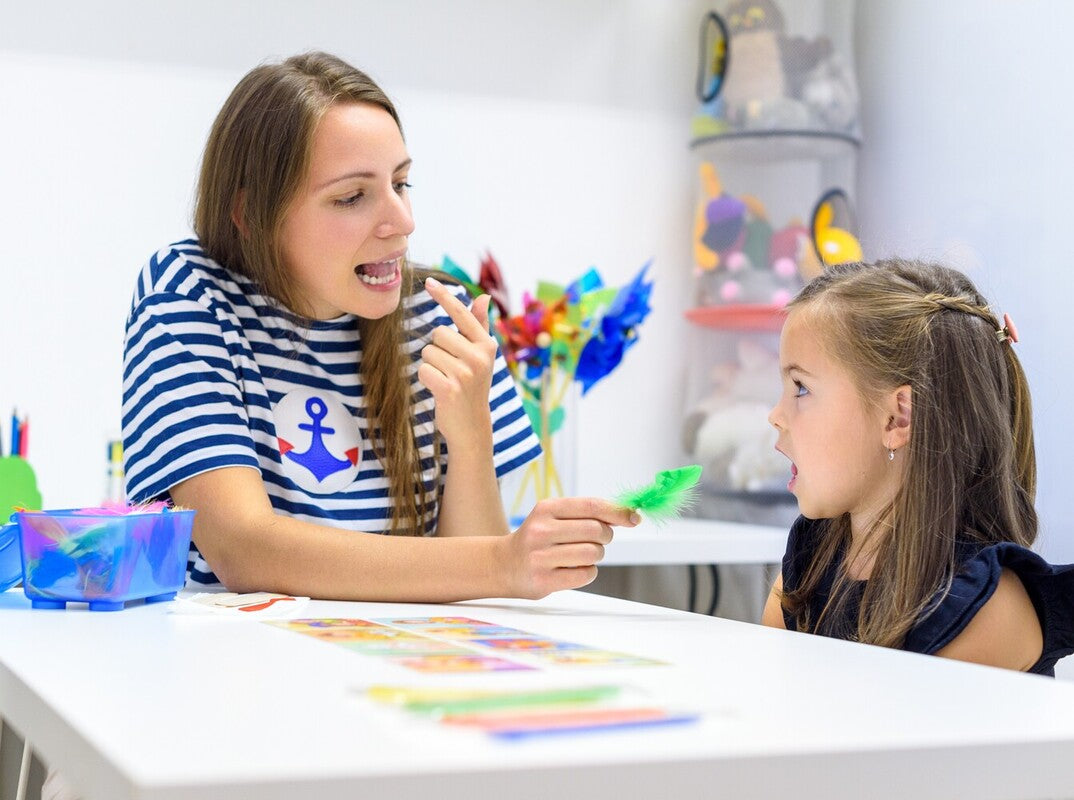
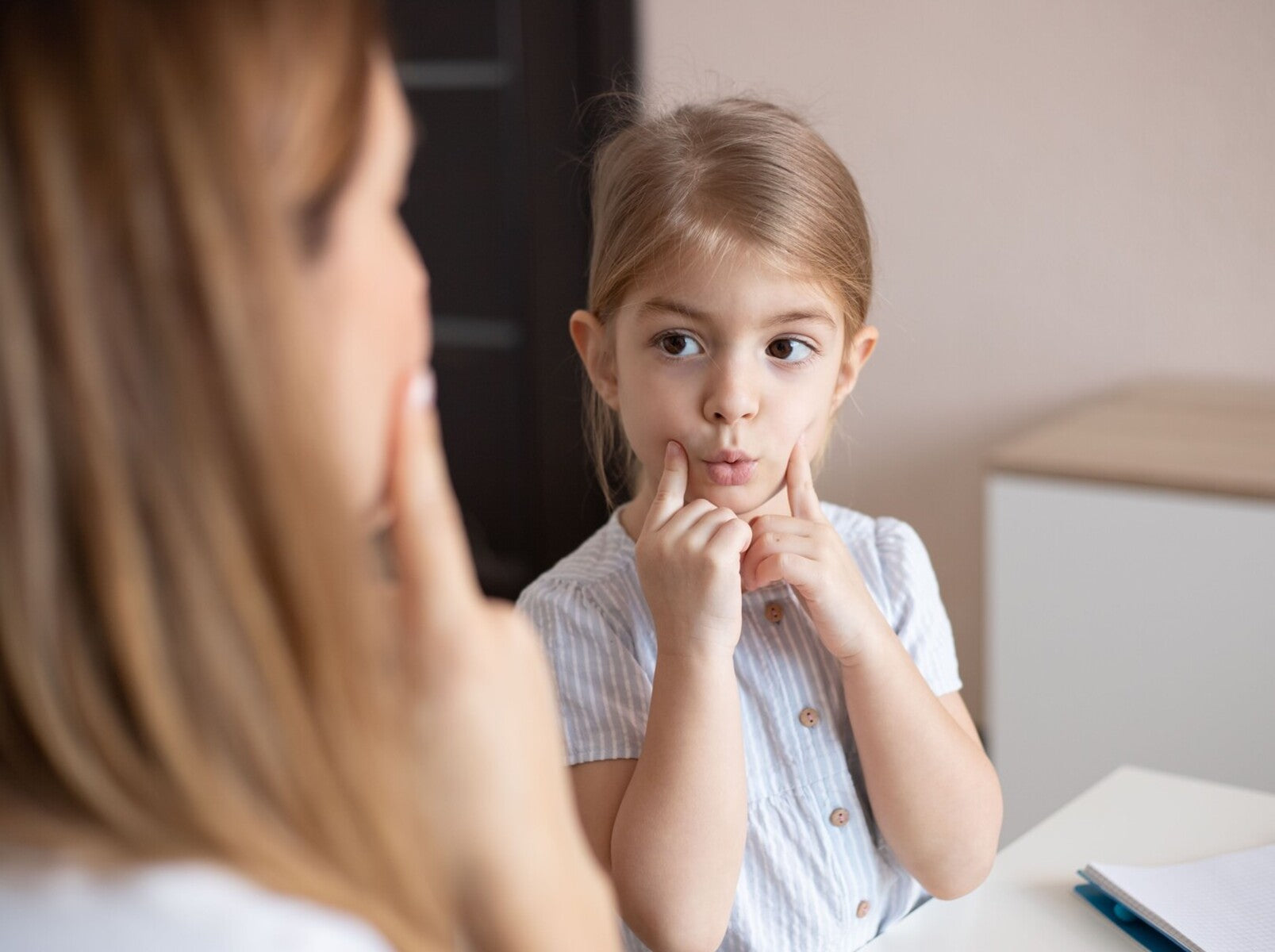
Many children with apraxia have difficulties with initial articulatory position, so we added these cues so that the clinician can quickly cue the child to have their speech articulators in the correct placement, before they even start to say the word.
In-Between Sound Cues
What we call “in-between sounds” are consonants that occur primarily in the medial consonant position of CVCV words in this deck. These are typically sounds that we consider to be voiceless consonants, but are actually released as the voiced cognate, in anticipation of the voiced vowel in the second syllable. For example, when saying “puppy” the medial /p/ is produced with some voicing, more like a /b/. Jennie and I have found in our experience that teaching this in-between sound more like the voiced cognate rather than the voiceless cognate leads to faster acquisition, generalization and more natural sounding speech.
We have marked on the cards the in-between sounds to remind the SLP to consider teaching the child the voiced cognate for the second syllable of these CVCV targets. In addition, many of those words have forward and backward chaining, so we have also included the chaining that includes the coarticulated in-between sounds.
Forward and Backward Chaining
Jennie and I use chaining a lot in therapy, so we included forward and backward chaining for many of the target words. Some cards include both forms of chaining.
Backward chaining is used when the child is producing an error in the last part of the word. For example, if the child is producing an error in the second syllable of a two-syllable word, we would backward chain by producing the second syllable several times, then adding the first syllable back to produce the entire word. This way, the part of the word that is in error is rehearsed and practiced correctly multiple times to increase the chances of being able to produce it correctly in the entire word. This may look like saying “knee,” “knee”, “knee” “tie-knee” (tiny).
Forward chaining is used when the child is producing an error in the first part of the word. The segmentation of the word is the same as in backward chaining, but the first syllable of the word is rehearsed several times before adding on the second syllable to produce the entire word. This may look like saying “tie,” “tie,” “tie,” “tie-knee” (tiny).
Bjorem Speech Sound Cues
For many targets, we also included the component Bjorem Speech Sound Cues on the back. This way, if the child is familiar with the Bjorem Speech Sound Cues, the SLP can quickly flip the card over to show the child the cues or easily pull the appropriate sound cues to use.
STOP Movement Cues
On the back of the cards, we included a stop sign after the words to help remind the SLP and the child that their movement and voicing should stop at the end of the word. We also included stop signs after the Bjorem Sound Cues and/or the pictures of other words from the deck. We encourage the SLP to consider using a gesture (such as putting their hand up) at the end of the word or using a stop sign to help a child stop moving their speech articulators and turn off their voice at the end of the word.
Many children with apraxia have difficulty with the timing of voice offset time as well as stopping their movement. If they continue voicing and or moving (such as dropping their jaw) an intrusive schwa is the likely result. We included these stop movement cues for children with apraxia who are working on improving their timing and movement control.
Words in Words Cues
We included lots of words in words cues in this deck. In our clinical experience, tackling a new word can be intimidating for children with apraxia, who may have experienced a lot of failures when trying new words in the past. We find that if we are able to break a new word down into component parts that are familiar to the child, the child is more willing to try and more resilient as we work on a new word. For words in this deck that can be broken down into smaller words, we included those smaller words, their pictures and even the card number on the back of the bigger word.
This way the SLP can quickly and easily flip the card over or pull the relevant card to help the child see the familiar words that make up the new word. In addition, if backward or forward chaining is needed, the SLP can use the component word cards as a visual. For some of the reduplicated CVCV cards that are composed of repeating a word in the deck twice (such as saying “two” twice for “tutu”), we included a larger picture of that component word twice so that the SLP could show the child the back of the card for cueing, since there are not two copies of the component word in the deck.
Lexical Stress
Incorrect or even-and-equal stress is common for children with apraxia. With that in mind, we marked the stressed syllable on all two syllable words in this deck. We did this primarily as a reminder for the SLP to make sure to model the correct lexical stress and not accidentally model and teach even-and-equal stress.
Keep in mind that stress is indicated by loudness, duration (length) and pitch. If a child is struggling to stress the correct syllable, consider cueing them to produce that syllable louder and/or for longer. Gestural cues to indicate length or tactile cues can be helpful to produce the syllable louder and longer. SLPs should be mindful to make sure that they are maintaining the appropriate relative stress of the syllables, even when using techniques such as backward or forward chaining.
Five Ways to Use Grab & Grow Apraxia Targets for Early Syllable Shapes
1. Ideas for Target Selection
We suggest looking at the lists of targets words on the dividers and narrowing the list using the child’s sound and syllable repertoires. Then sit down with the family and go through words that the child is stimulable for in order to select words that are important to that child. Remember to always pick targets from a variety of syllable shapes!
2. Build On Words
Consider words that a child is already producing accurately and consider if you can combine any of these words into longer words or phrases or if components of these words could be broken out and combined with other component words. For example, if a child is producing the word “go,” perhaps it can be combined with “I” for the phrase “I go.” Or if the child is producing the word “Daddy,” perhaps the second syllable (dee) can be isolated and then combined with other syllables to produce other words such as “muddy.”
3. Practice Cueing Strategies
We hope that this deck will help SLPs who are new to apraxia therapy to learn a lot more cues. While we can’t be there to personally mentor each of you, we hope you’ll feel like you still have an experienced apraxia therapist in your back pocket, providing cueing ideas. We recommend practicing the cues outside of therapy, so that you are able to slow your rate without segmenting or using even-and-equal or inappropriate stress. Overall, we hope that this deck is a small, daily piece of continuing education.
4. Parent Education
The backs of the cards can be used to help provide parent education about the cues that the SLP is using in therapy and the cues that the parent can use at home for carryover.
5. Incorporate Play
We do not suggest using these cards as flashcards, unless that is the child’s preferred way to play. Rather, we encourage the SLP to incorporate these cards into play and/or games, as a visual reminder for both the SLP and the child of the speech targets they are working on.
Coming Soon
Jennie and I are currently working on workbooks to accompany the Grab & Grow Apraxia Targets for Early Syllable Shapes deck. These workbooks are filled with activities to provide extra cueing and practice for the words in the deck. Stayed tuned!
Questions? Comments?
Questions or comments? Let us know!