At Bjorem Literacy, we spend our days elbow-deep in the science of how children learn to talk and connect. One question comes up in nearly every conversation we have with parents: does reading really make a difference?
The short answer is yes, and understanding the importance of reading to kids is one of the best ways to set your child up for success. Reading to your child is one of the simplest, most powerful tools you have for building language and strengthening young minds.
It also creates a connection that lasts well beyond the last page. You don't need a special degree or a stack of flashcards to start. You just need a book and a few minutes a day.
Why Is Reading to Children Important?
The benefits of reading to children go far beyond passing time before bed. Here's what the research, and our own clinical experience, both point to:
1. Builds Vocabulary and Language Skills
Every book you open introduces new words, and those words add up fast. Consistent daily reading and talking exposes a child to thousands more words than they'd hear in everyday conversation alone, and that kind of exposure builds a real head start heading into kindergarten (Karrass & Braungart-Rieker, 2005).
Books also carry vocabulary kids rarely hear day-to-day, words about penguins and glaciers, for example, giving them language they'll need for reading and for talking about their own world.

2. Strengthens Brain Development
Reading does something remarkable to the brain. Reading aloud activates brain areas tied to language processing, memory formation, visual imagery, and emotional response, all within the same few minutes (Hutton, Horowitz-Kraus, Mendelsohn, DeWitt, & Holland, 2015. Every story a child hears helps build the neural pathways they'll rely on for years to come.
3. Deepens Emotional Bonding and Connection
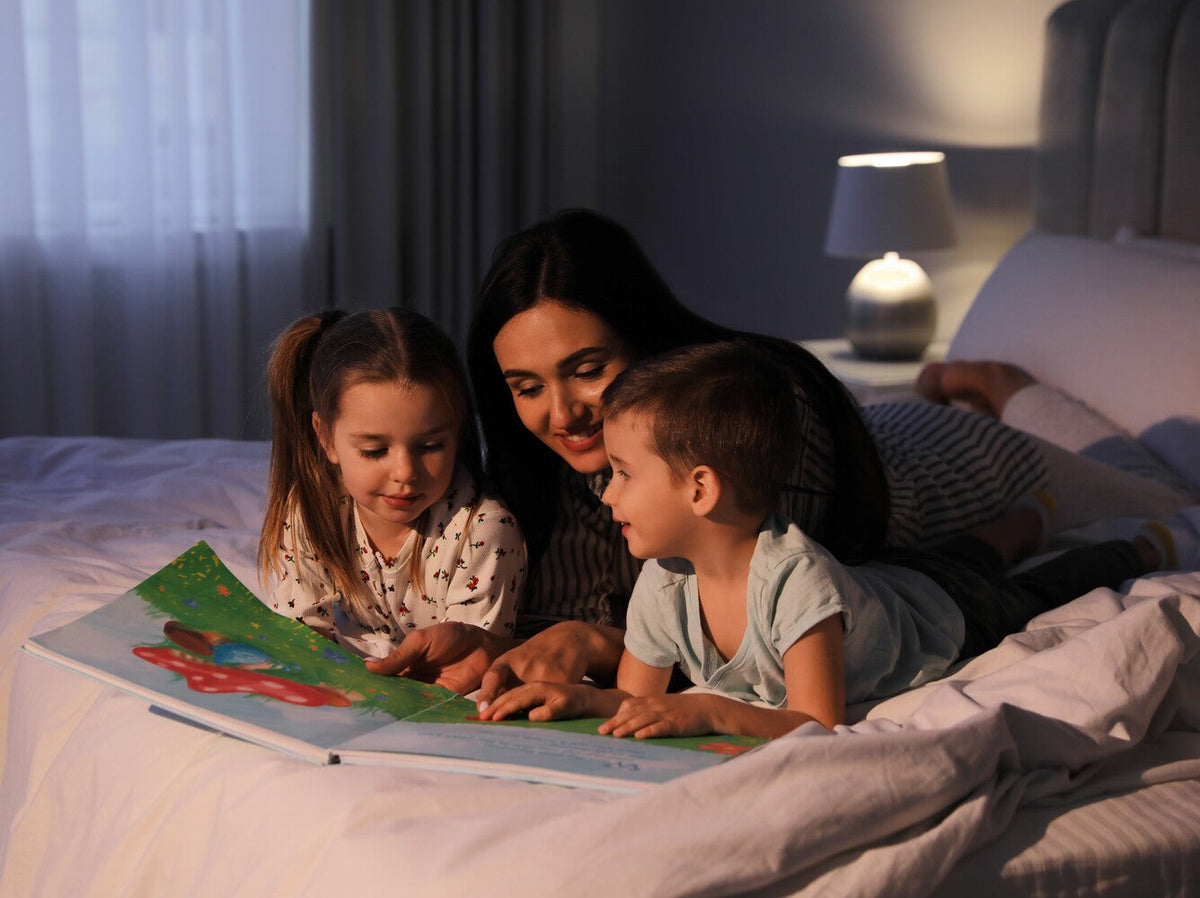
Story time is also relationship time. Snuggling up with a book gives children a predictable, calm routine, and that predictability builds a sense of security. Reading to very young children regularly has also been linked to lower levels of aggression and hyperactivity, likely because stories give kids the words to describe feelings that are otherwise hard to express (Mendelsohn et al., 2018).
Stories also give kids a safe space to talk through big feelings, whether that's a monster who feels mad or a character starting school for the first time. That kind of practice helps children build the words for their own emotions.
4. Lays the Foundation for Academic Success
The advantages of early reading follow children well into their school years. Infants who are read to regularly are more likely to count to 20 and recognize letters by the time they start school (Duursma, Augustyn, & Zuckerman, 2008).
These early literacy skills give kids a running start, not just in reading class but across every subject that depends on strong language. The habit you build at home today becomes the confidence your child carries into the classroom.

5. Builds Listening and Attention Skills
Listening to a story asks a lot of a young brain. Kids have to track the plot while holding details in mind long enough to make sense of what comes next (Hutton, Dudley, Horowitz-Kraus, DeWitt, & Holland, 2019).
That kind of sustained listening is exactly the skill they'll lean on in a classroom and when following multi-step directions at home. The more practice a child gets tuning in to a story, the stronger that attention muscle becomes.
6. Expands Imagination and Critical Thinking
Stories take kids to places they've never been, from a farm at sunrise to a spaceship headed for Mars. That kind of imaginative stretch helps children practice cause and effect, since every plot has a problem and a resolution (Mar, Tackett, & Moore, 2010.
Asking a simple question, like what do you think happens next, builds critical thinking skills that carry over into problem-solving well beyond story time.
How Does Reading Affect a Child's Development?
Reading affects a child's development on multiple fronts at once. The American Academy of Pediatrics notes that reading regularly with young children stimulates healthy patterns of brain development and helps build skills that last a lifetime, from language and literacy to social-emotional growth (American Academy of Pediatrics, Council on Early Childhood, 2014).
On the language side, hearing new words in context day after day builds vocabulary faster than everyday conversation alone can. Cognitively, following a story from beginning to end strengthens memory and the ability to predict what happens next. Socially and emotionally, characters give kids a low-pressure way to practice empathy and put words to their own feelings.
Reading time can also be a helpful window into how your child is progressing. If your toddler seems uninterested in books or isn't picking up new words the way you'd expect, it's worth paying attention. If noticed alongside other signals, like better understanding than speaking, it could be a sign of language or speech disorders in children. Don't wait - evaluate.
Early intervention with a speech-language pathologist can figure out whether what you're seeing is a normal variation or something that could benefit from support, and early support tends to make the biggest difference.
Pairing story time with speech therapy tools, built around specific sounds or vocabulary goals, can reinforce what your child is already learning on the page.
Want to do more to help your child? Read our guides on how to help my child with reading comprehension and how to help a child struggling with reading.

Conclusion
Reading to your child is one of the easiest, most impactful habits you can build into your day. It grows vocabulary, shapes the brain, deepens your bond, and sets the stage for school success, all from a few quiet minutes together. You don't have to do it perfectly. You just have to keep showing up with a book.
At Bjorem Speech, we build tools designed by speech therapists to support every stage of your child's speech and language journey, whether you're reading a story tonight or working through a specific speech goal. Keep turning pages, keep talking about what you read, and trust that every story is doing more for your child than you might realize.
Sources:
-
American Academy of Pediatrics, Council on Early Childhood (High, P.C., Klass, P., Donoghue, E., Glassy, D., DelConte, B., Earls, M., Lieser, D., McFadden, T., Mendelsohn, A., Scholer, S., Schulte, E.E., Takagishi, J., Vanderbilt, D., & Williams, P.G.). (2014). Literacy Promotion: An Essential Component of Primary Care Pediatric Practice. Pediatrics, 134(2), 404 to 409. https://doi.org/10.1542/peds.2014-1384
-
Duursma, E., Augustyn, M., & Zuckerman, B. (2008). Reading aloud to children: the evidence. Archives of Disease in Childhood, 93(7), 554 to 557. https://doi.org/10.1136/adc.2006.106336
-
Hutton, J.S., Dudley, J., Horowitz-Kraus, T., DeWitt, T., & Holland, S.K. (2019). Functional connectivity of attention, visual, and language networks during audio, illustrated, and animated stories in preschool-age children. Brain Connectivity, 9(7), 580 to 592. https://doi.org/10.1089/brain.2019.0679
-
Hutton, J.S., Horowitz-Kraus, T., Mendelsohn, A.L., DeWitt, T., & Holland, S.K. (2015). Home reading environment and brain activation in preschool children listening to stories. Pediatrics, 136(3), 466 to 478. https://doi.org/10.1542/peds.2015-0359
-
Karrass, J., & Braungart-Rieker, J.M. (2005). Effects of shared parent-infant book reading on early language acquisition. Journal of Applied Developmental Psychology, 26(2), 133 to 148. https://doi.org/10.1016/j.appdev.2004.12.003
-
Mar, R.A., Tackett, J.L., & Moore, C. (2010). Exposure to media and theory-of-mind development in preschoolers. Cognitive Development, 25(1), 69 to 78. https://doi.org/10.1016/j.cogdev.2009.11.002
-
Mendelsohn, A.L., Cates, C.B., Weisleder, A., Berkule Johnson, S., Seery, A.M., Canfield, C.F., Huberman, H.S., & Dreyer, B.P. (2018). Reading aloud, play, and social-emotional development. Pediatrics, 141(5), e20173393. https://www.ncbi.nlm.nih.gov/pmc/articles/PMC5914489/