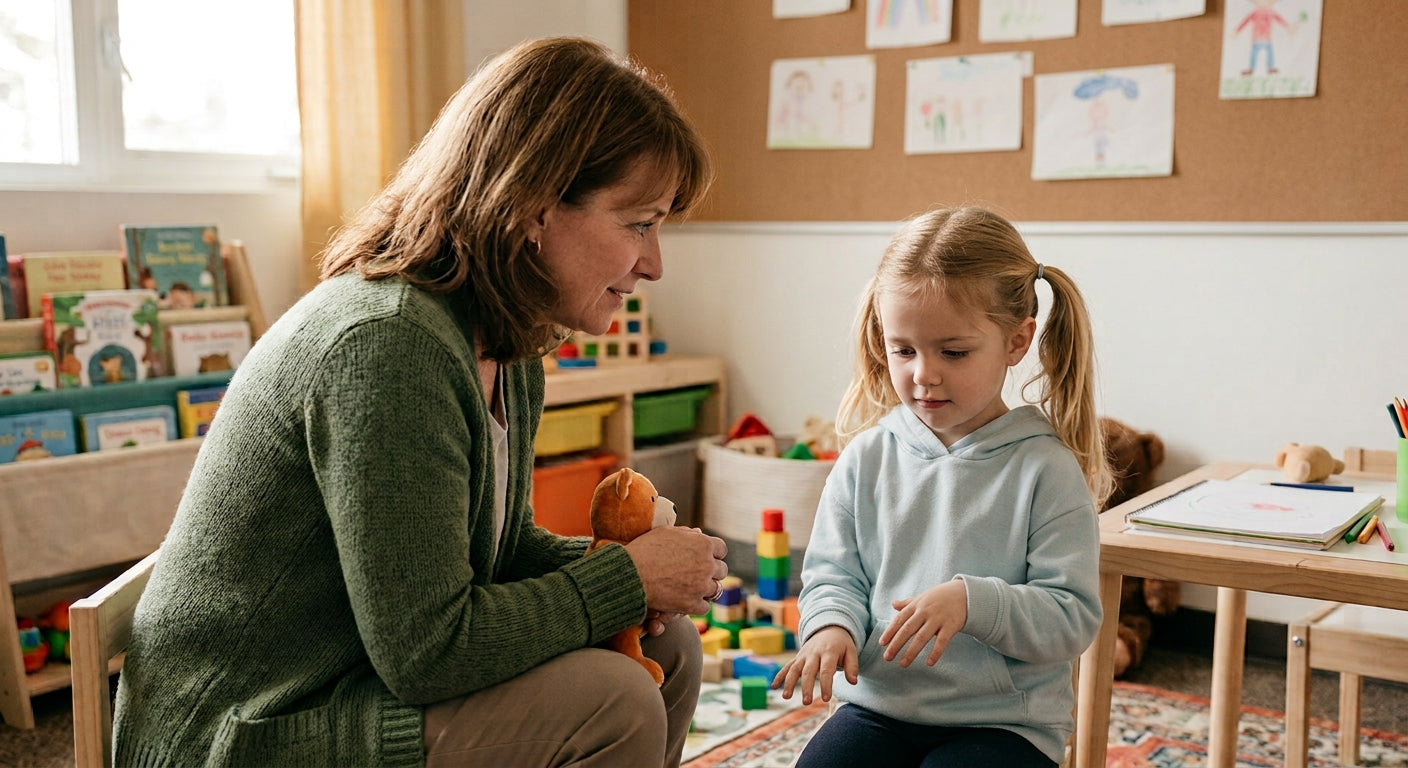
Imagine a four-year-old who talks nonstop at home—telling elaborate stories, singing songs, and sharing everything she knows about dinosaurs. Then she walks into preschool and becomes silent. Weeks pass. Then months.
Her teacher describes her as “very shy.” Family members reassure her parents that she will talk when she is ready. But her parents recognize something important: the child they see at home is not the same child others are seeing at school.
This is often how selective mutism first becomes apparent—and why it can be so easily misunderstood.
What Is Selective Mutism?
So, what is selective mutism, exactly? Selective mutism (SM) is an anxiety-based communication disorder in which a child consistently has difficulty accessing spoken communication in specific social situations where speaking is expected, such as school, therapy, or community settings, while speaking more comfortably in other environments, often at home with immediate family.
The key word is consistently. This is more than shyness, a quiet day, or needing a little extra time to warm up. It is a persistent, situation-specific pattern that lasts for at least one month and extends beyond the first month of a new school year.
According to the DSM-5-TR, the difficulty speaking must interfere with educational or occupational achievement or social communication and cannot be better explained by a lack of knowledge of, or comfort with, the language being used. It is also important to recognize that children with selective mutism may have co-occurring speech, language, sensory, or motor-planning differences. These individual differences do not necessarily rule out selective mutism—in fact, they may contribute to how easily a child can access communication when anxiety is present.
Most importantly, a child with selective mutism is not choosing not to speak. They may know exactly what they want to say and still be unable to access their voice in that moment.
Is Selective Mutism an Anxiety Disorder?
Yes. Selective mutism is an anxiety disorder, classified in the DSM-5-TR alongside other anxiety disorders rather than as a communication disorder. This distinction is important because it changes how we understand the child. Instead of asking, “Why won’t this child talk?” we begin to recognize that the child may not be able to reliably access spoken communication when their nervous system is overwhelmed.
For many children with selective mutism, anxiety can create a very real physiological response. Older children and adults often describe knowing exactly what they want to say but feeling as though the words simply will not come out. Their body may become still, their facial expression may change, and even movements or communication that are easy in comfortable environments can suddenly become difficult. This is not defiance, stubbornness, or a choice.
Although selective mutism is not classified as a communication disorder, communication is significantly impacted—which is why speech-language pathologists can play such an important role in assessment and intervention. Children with SM may also have co-occurring differences in speech, language, motor planning, sensory processing, or social communication. Understanding these individual differences helps us see beyond the silence and consider the many factors that may affect a child's ability to communicate when anxiety is present.
Ultimately, selective mutism is an anxiety disorder that shows itself through communication, and effective support requires us to understand both.
Selective Mutism Symptoms in Children
The symptoms of selective mutism extend well beyond whether or not a child speaks. Because anxiety can affect the whole nervous system, clinicians and caregivers may notice differences in communication, movement, facial expression, engagement, and participation depending on the environment.
Signs may include:
- Speaking comfortably and spontaneously at home while using significantly less—or no—spoken language at school or in other settings
- Using nonverbal communication such as pointing, nodding, gestures, writing, or AAC when speech is difficult to access
- Appearing physically “frozen,” with limited movement or a blank facial expression that may be mistaken for disinterest
- Looking away, turning the body, hiding behind a caregiver, or having difficulty engaging with unfamiliar people
- Difficulty initiating communication, even when the child may be able to respond to others
- Difficulty with nonverbal actions such as waving, pointing, making a choice, eating in front of others, or using the restroom at school
- Needing additional processing time before responding
- Whispering or speaking with only certain trusted people
- Speaking when a trusted peer or caregiver is present but becoming quiet when another person enters the interaction
- Communicating more freely during play or movement than during direct, face-to-face interactions

For preschoolers with selective mutism, these signs are sometimes attributed to shyness or difficulty adjusting to a new environment. SM often becomes more noticeable when children enter preschool or school and the social and communication demands increase.
Looking beyond speech is important. A child who is having difficulty accessing their voice may also be showing us through their body, movement, and engagement that their nervous system is working hard to manage the demands of the environment.
What Causes Selective Mutism in Children?
There is no single cause of selective mutism. Rather, SM is thought to develop through a combination of biological, genetic, developmental, and environmental factors.
Research suggests that many children with selective mutism have a genetic predisposition toward anxiety or a temperament characterized by behavioral inhibition. The brain’s threat-detection system may also play a role. In particular, the amygdala may be more reactive to perceived social or communication demands, signaling danger even when the situation is objectively safe. When this happens, the nervous system can shift into a protective response—such as fight, flight, freeze, fawn, fatigue, or flood—making speech, movement, engagement, and communication more difficult to access.
Environmental factors also matter, but this does not mean that parents or caregivers cause selective mutism. New environments, unfamiliar people, increased social or speaking demands, school transitions, or other stressful experiences may interact with a child's underlying vulnerability to anxiety. Individual differences in sensory processing, motor planning, speech, or language may add another layer of challenge for some children.
Selective mutism is also not typically caused by trauma, poor parenting, or a child being stubborn or spoiled. While trauma can certainly affect communication and should be considered when clinically relevant, it is not considered the primary cause of SM for most children.
Ultimately, selective mutism is best understood as multifactorial. Genetics may create a vulnerability, an over-reactive threat response may make certain situations feel unsafe, and environmental and developmental factors can influence when and where that anxiety appears. Understanding this helps us move away from looking for someone or something to blame and toward understanding the individual child and what their nervous system needs to feel safe, connected, and able to communicate.
Selective Mutism vs Social Anxiety: How They Differ
Selective mutism and social anxiety can overlap, and some children experience both. However, they are not the same.
Social anxiety involves a broader fear of social situations, often related to being judged, embarrassed, or negatively evaluated. Selective mutism is characterized by a consistent inability to access spoken communication in specific situations, despite speaking comfortably in others.
A child with SM may actually enjoy being around others, participate in play, and appear socially engaged while remaining unable to speak. In contrast, a child with social anxiety may speak but experience significant anxiety across a wider range of social interactions.
Understanding the difference helps us recognize that silence does not necessarily mean a child does not want to engage or connect with others.
Supporting Children With Selective Mutism
At Bjorem Speech, we believe the most useful thing an adult can do is lower the pressure and raise the opportunity. Effective approaches build communication in small, deliberately graded steps, moving a child from nonverbal responses to sounds, to single words, to phrases, in settings that gradually widen.
Visual cues, predictable routines, and play-based materials give children a low-stakes on-ramp instead of a spotlight. Progress is real, and it is rarely fast. Anyone promising a quick fix is selling something.
For clinicians who want a structured framework rather than a collection of loose strategies, DIR®-SM: A Developmental Approach to Selective Mutism Intervention was created by Dr. Joleen Fernald, PhD, CCC-SLP, one of our longtime collaborators.

The 73-card deck walks practitioners through where a child currently sits within the Functional Emotional Developmental Capacities hierarchy, then maps a path forward across five stages: regulation, engagement, purposeful two-way communication, the Systematic Sound Sequencing Strategy, and shared social problem solving. It accounts for the whole child, including co-occurring speech, language, and sensory processing differences, which is precisely where generic anxiety protocols tend to fall short.
The deck is available on its own or bundled with a 2 PDH professional development course.
See also:
How to Treat Selective Mutism: What Helps and What Does Not?
Selective Mutism Therapy: Treatment Options, Strategies, and Goals That Work
Selective Mutism and Autism: How They Overlap, Differ, and Why the Distinction Matters
Frequently Asked Questions About Selective Mutism
My child talks constantly at home but has not spoken a word at school all year. Is that selective mutism or just shyness?
The distinction comes down to consistency, duration, and impairment. A shy child usually warms up over a few weeks and eventually speaks to a teacher or a peer, even quietly, whereas a child with selective mutism shows a stable pattern of not speaking in that setting for a month or longer while speaking normally elsewhere. If your child's silence is interfering with learning, friendships, or basic needs like asking to use the restroom, that is your signal to request an evaluation from a speech-language pathologist or a psychologist familiar with anxiety in young children rather than waiting another semester.
Who actually diagnoses selective mutism, and what happens during an evaluation?
A psychologist, psychiatrist, or other mental health practitioner, developmental pediatrician, or in many cases a speech-language pathologist with advanced training in selective mutism can identify SM, and the professional you start with often depends on who noticed the pattern first. Because the child almost certainly will not speak to a stranger in an unfamiliar office, a competent evaluation leans on parent and teacher reporting, standardized anxiety and communication questionnaires, home video recordings of your child speaking freely, and direct observation in the settings where the silence occurs. Expect the clinician to also screen speech, language, and hearing, since a co-occurring difference in any of those areas changes the intervention plan considerably and is easy to miss when a child is not talking.
Can my child qualify for school support if her grades are fine?
Academic performance is not the only measure of educational impact, and this is the point most families need help articulating in a meeting. A child who cannot ask to use the restroom, request help, read aloud, participate in group work, or report being hurt on the playground is experiencing a significant barrier to accessing her education regardless of what her report card says. In the United States, selective mutism can support eligibility for an individualized education program, individualized accommodation plan, or a 504 plan depending on how the impact is documented, so go into the conversation with specific examples of what your child cannot do at school rather than a diagnosis label alone.
Our teacher offers a sticker if my son says one word in class. Is that actually helping?
Offering a sticker or other reward for speaking may be well-intentioned, but for a child with selective mutism, it can unintentionally increase the pressure to talk. If the child is unable to access speech because their nervous system is overwhelmed, adding a reward does not make speech more accessible—it may simply make the child more aware that everyone is waiting for them to talk.
Instead of rewarding speech, focus on creating an environment where the child feels safe, regulated, and connected. Accept and respond to all forms of communication, including gestures, pointing, writing, AAC, sounds, or whispering, and gradually support the child toward spoken communication as they are ready.
We absolutely want to celebrate a child's progress, but the goal is for communication to grow through connection and meaningful interaction—not because speaking is required to earn something.
Will my child simply grow out of it if we give it more time?
Waiting is the single most common and most costly decision families make, because selective mutism does not typically resolve on its own and every silent day reinforces the avoidance loop that sustains it. Some children do improve with age, but many carry the pattern into adolescence along with a widening gap in academic participation and social confidence. The encouraging news is that structured, graded intervention has a strong track record, particularly with younger children, so acting on your instinct now costs far less than the years spent hoping.
What can we realistically expect from therapy, and how long does progress take?
There is no set timeline for progress with selective mutism. Every child is different, and progress depends on many factors, including the child’s individual differences, level of anxiety, developmental capacities, relationships, and the environments in which communication is expected.
Progress is often gradual and incremental. Early changes may not involve speech at all—a child may become more comfortable entering a space, engaging with another person, initiating play, communicating nonverbally, or making sounds before spoken words emerge.
Rather than focusing on how quickly a child talks, we want to notice and build upon these small but meaningful changes in regulation, engagement, and communication. Collaboration between caregivers, clinicians, and school staff can also help the child feel supported consistently across environments.
With selective mutism, progress is not just measured by words spoken, but by a child’s growing capacity to connect, communicate, and participate.