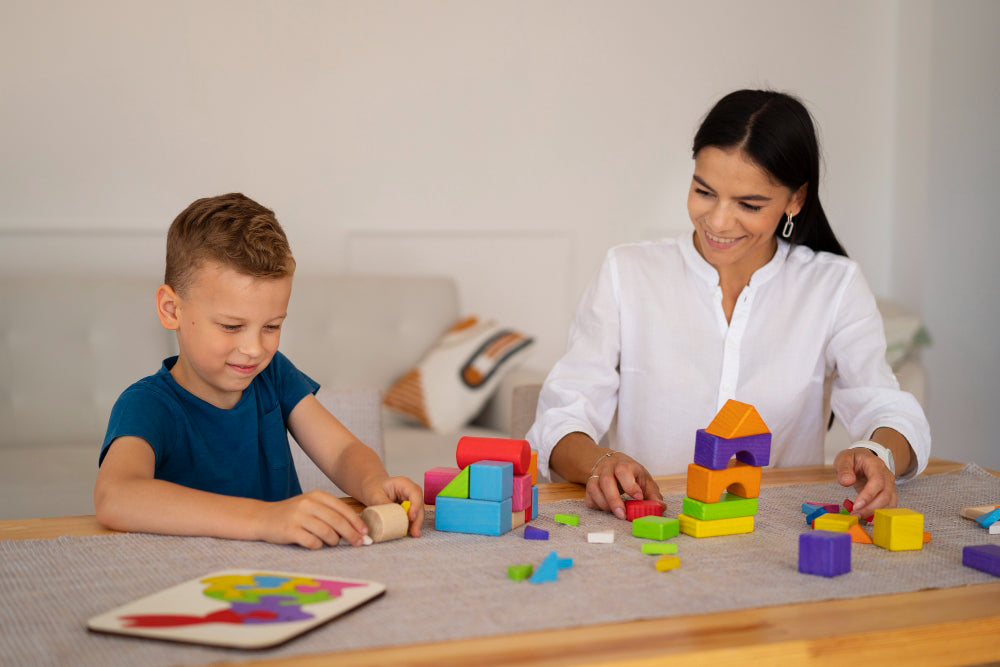
The therapy room is warm and welcoming. The clinician is kind. The activities are fun. A reward is waiting for the child if they can answer the question, say the word, or use their “brave voice.” Week after week, everyone patiently encourages just a little more talking. And yet, months later, the child still freezes when speech is expected—or they speak in therapy but remain unable to use their voice at school, with unfamiliar adults, or in other situations that feel unsafe.
This is where many traditional behavioral approaches to selective mutism can fall short. They focus on changing the behavior we can see—silence—without fully understanding what is happening underneath it. For a child with selective mutism, speech is not simply a behavior that needs to be shaped or reinforced.
Access to voice is closely connected to regulation, emotional safety, sensory processing, motor planning, relationships, and the child’s individual nervous system. Treatment becomes much more meaningful when the goal shifts from “How do we get this child to talk?” to “What does this child need in order to feel safe, regulated, connected, and able to communicate?”
What Selective Mutism Therapy Involves, and When to Start
Effective selective mutism therapy is not about disguising exposure as play or creating increasingly difficult demands for speech. Play should not be a tool used to coax a child into talking. It is a powerful way to build connection, support regulation, understand a child’s individual differences, and create the emotional safety needed for spontaneous communication to emerge.
For many children with selective mutism, access to speech changes depending on the person, environment, sensory demands, level of regulation, and sense of safety in the moment. This is why treatment needs to look beyond the presence or absence of spoken words. Before asking, “How can we get this child to talk?” we need to ask, “What is making communication difficult right now, and what can we change to help this child feel safe enough to engage?”
That does not mean therapy is passive or that we simply wait for a child to speak. Effective treatment is intentional and individualized. We actively support regulation, engagement, shared attention, nonverbal communication, sound-making, motor planning, and increasingly complex interactions. We create opportunities for the child to experiment with their voice without making speech the price of participation. Progress may begin with a gesture, a shared laugh, a sound during movement, a whisper, or a spontaneous word with a trusted person. Each of these provides valuable information about what helps that child's communication system become more accessible.
Early support is important, but not because a child needs to be pushed through an exposure hierarchy before their “avoidance” becomes entrenched. Early intervention gives us the opportunity to reduce pressure, prevent unhelpful interaction patterns from developing, support families and teachers, and help the child experience communication as safe and successful. Preschool and the early elementary years offer an important opportunity for intervention, but children, adolescents, and teens with selective mutism can make meaningful progress as well.
The goal of therapy for selective mutism is not simply to produce speech in the therapy room. It is to help the child develop a sense of safety, agency, and communicative confidence that can gradually extend across people, places, and experiences.
Selective Mutism Treatment Options Supported by Evidence
There are several selective mutism treatment options, and while they share the goal of helping children communicate more comfortably across environments, they do not all approach that goal in the same way. Some are grounded primarily in behavioral principles and external reinforcement, while others place greater emphasis on intrinsic motivation, relationships, regulation, communication, and the individual differences that influence a child's ability to access speech.
Understanding these differences can help families choose an approach that fits both their child and their own values.
- DIR-Selective Mutism (DIR-SM). A developmental, relationship-based approach that looks beyond the behavior of speaking or not speaking. DIR-SM considers regulation, relationships, sensory processing, motor planning, individual differences, and the child's overall capacity for communication. Rather than using rewards or compliance to elicit speech, intervention builds from emotional safety, connection, intrinsic motivation, and meaningful interactions.
- The Selective Mutism Resource Manual approach. Developed by Maggie Johnson and Alison Wintgens, this framework provides practical strategies for reducing anxiety and supporting communication across home, school, and community environments. It emphasizes careful pacing, reducing pressure, and helping the child gradually become more comfortable communicating.
- Brave Muscle Method. Developed by Anna Biavati Smith, this approach uses the metaphor of building a child's "brave muscle" while supporting increasingly challenging communication experiences.
- Video Self-Modeling + Stimulus Fading + Reinforcement (VSR). This approach combines behavioral strategies with video self-modeling. Children can see themselves successfully speaking while stimulus fading is used to gradually introduce people or situations in which speaking is more difficult, with reinforcement incorporated into the process.
- Social Communication Anxiety Treatment (S-CAT). Developed by Dr. Elisa Shipon-Blum, S-CAT conceptualizes selective mutism as a social communication anxiety disorder and uses strategies designed to help children progress through stages of communication and generalize communication across people and settings.
- Cognitive Behavioral Therapy (CBT). CBT addresses the relationship among thoughts, feelings, anxiety, and behavior. Depending on the individual treatment model, CBT for selective mutism may incorporate strategies such as graded exposure, coping strategies, cognitive restructuring, and reinforcement.
- Parent-Child Interaction Therapy for Selective Mutism (PCIT-SM). Developed by Dr. Steven Kurtz, PCIT-SM adapts principles of Parent-Child Interaction Therapy for children with selective mutism. Parents are coached in specific interaction strategies, with treatment incorporating behavioral techniques and graduated practice with speaking.
- Applied Behavior Analysis (ABA). The most explicitly behavioral end of the continuum, ABA focuses on observable behavior and uses behavioral principles such as antecedents, reinforcement, prompting, shaping, and systematic changes in expectations to increase targeted behaviors, including verbal responding.
These approaches represent meaningfully different philosophies of treatment. The continuum in the accompanying graphic ranges from approaches emphasizing intrinsic motivation and less behavioral intervention to those relying more heavily on extrinsic motivation and behavioral strategies.
For families, the question therefore should not simply be, “Which selective mutism treatment uses exposure?” A better question is, “How does this approach understand my child's silence, and what does it believe needs to happen for communication to become more accessible?”
In DIR-SM, we do not view a nod, gesture, AAC response, written answer, or other form of communication as a failure because a spoken word was the target. Communication is communication. Those responses tell us that the child is engaging, connecting, and finding a way to participate. Rather than withholding acceptance of those responses to increase the demand for speech, we meet the child where they are and use that connection as the foundation for expanding communication.
This does not mean avoiding speech forever or simply waiting for the child to decide they are ready. Treatment remains active and intentional. We create opportunities for increasingly complex communication, carefully observe what supports or disrupts access to voice, and help the child expand their capacity to communicate across people, places, and situations—without making speech something they must perform to earn a reward, please an adult, or escape a demand.

Core Selective Mutism Strategies Every Plan Should Include
In DIR-Selective Mutism (DIR-SM) therapy, strategies are not chosen simply because they move a child closer to producing a spoken response. We first consider regulation, relationship, individual differences, and the child's current capacity for communication. The question is not, “How do I get the next word?” but “What is keeping this child from accessing communication right now, and how can I support that system?”
Three principles guide much of this work:
1. Start with regulation, safety, and connection
Before focusing on speech, we look at whether the child feels safe and regulated enough to engage. A child who is in a fight, flight, freeze, fawn, fatigue, or flood response may not have access to the same communication abilities they demonstrate when comfortable and regulated.
This is where DIR-SM differs significantly from approaches that begin with a speaking hierarchy. We may use movement, sensory input, humor, predictable routines, shared interests, parallel play, or simply time together to support regulation and connection. The goal is not to use these activities as a disguised way to elicit speech. Regulation and relationship are part of the treatment.
2. Follow the child's communication—not just their speech
Communication develops long before we hear an audible word. A child may communicate through proximity, facial expressions, gestures, pointing, movement, AAC, writing, sounds, whispers, or spoken language. In DIR-SM, these are not merely “approximations” that need to be shaped into a more desirable behavior. They are meaningful forms of communication.
We join the child at the level of communication currently available and then create playful, meaningful opportunities to expand it. For one child, that might mean moving from gestures to shared sounds. For another, it might be experimenting with silly noises during movement or using their voice spontaneously during highly motivating play. Another child may already speak comfortably with one person and need support carrying that sense of safety and connection into a relationship with someone new.
The progression is individualized rather than predetermined. We are expanding the child's capacity for communication, not reinforcing successive approximations until we obtain speech.
3. Reduce communication pressure and make interaction feel natural
How adults interact with a child can either increase or decrease the demand associated with communication. Rather than positioning ourselves face-to-face and asking a series of questions, we might sit beside the child, join what they are doing, use declarative language, make playful comments, wonder aloud, and allow interactions to develop naturally.
We also give the child time to process and respond—but without turning that wait into another demand. Five seconds of adults silently watching for an answer can feel much longer to a child with selective mutism. If the child does not respond verbally, we continue the interaction rather than allowing the moment to become a standoff over speech.
Most importantly, we respond to the communication the child gives us. A gesture, point, facial expression, AAC response, or movement keeps the interaction going and tells the child, “I hear you. Your communication matters.”
Over time, as regulation, engagement, trust, and communicative capacity grow, we can intentionally support the child in expanding their voice across relationships and environments. The goal is still progress—but in DIR-SM, progress is built through connection, intrinsic motivation, agency, and emotional safety rather than compliance, reinforcement, or pressure to perform.
Speech Therapy Goals for Selective Mutism
Writing speech therapy goals for selective mutism begins with identifying where the child is developmentally—not simply whether they are speaking. In DIR-Selective Mutism (DIR-SM), I use a developmental hierarchy based on the Functional Emotional Developmental Capacities (FEDCs) and the Systematic Sound Sequencing Strategy (SSSS) to determine where intervention should begin and what the next meaningful goal might be.
This is an important distinction. DIR-SM absolutely has a hierarchy, but it is not a hierarchy of increasingly difficult speaking demands. Instead, we look at the developmental capacities that support communication and gradually build from regulation and engagement to intentional communication, sound production, and ultimately spontaneous verbal communication.
The progression may look like this:
- Regulation and Attention (FEDC 1): The child is able to remain regulated and available for interaction. An early goal might be: The child will participate in sensorimotor activities with the therapist while maintaining regulation and shared attention.
- Engaging and Relating (FEDC 2): Once the child is comfortable enough to engage in a relationship, communication can begin to expand. Goals may include responding to or initiating interaction through gestures, facial expressions, movement, or other nonverbal communication.
- Two-Way Intentional Communication (FEDC 3): This is where we begin looking more closely at increasingly complex circles of communication. The child may respond to or initiate with gestures and then begin experimenting with voice and sound within reciprocal interactions.
Within FEDC 3, the Systematic Sound Sequencing Strategy (SSSS) provides additional steps for supporting access to voice. The progression documented on my DIR-SM data collection form includes responding and initiating through body sounds, mouth sounds, phonemes, segmented phonemes that form words, and blended phonemes that form words. Whispering may also be part of the child's communication profile.
Goals might therefore include:
The child will respond to the therapist during a reciprocal interaction using a body sound.
The child will initiate a circle of communication using a body or mouth sound during a preferred sensorimotor activity.
The child will respond to or initiate interaction by producing a phoneme during playful engagement with the therapist.
The child will combine or segment phonemes to create a recognizable word within a reciprocal interaction.
The child will blend phonemes to produce words during spontaneous, meaningful interactions with a familiar communication partner.
- Purposeful Problem Solving (FEDC 4): As the child's regulation, engagement, intentionality, and access to voice become stronger, goals can increasingly focus on flexible and spontaneous verbal communication. The goal is not simply for the child to answer questions. We want the child to use their voice to initiate, respond, negotiate, protest, request, share ideas, solve problems, and remain in longer reciprocal interactions.
This hierarchy also gives us a much richer way to measure progress. A child who has not yet spoken a word may still have moved from simply tolerating the therapist's presence, to participating in a sensorimotor activity, to engaging through gestures, to initiating an interaction, to making a body sound in response, and then to experimenting with mouth sounds or phonemes. Those are meaningful developmental changes, and they should be reflected in our data and our goals.
The DIR-SM data collection form allows us to track exactly these changes across sessions—from nonverbal participation and sensorimotor engagement through gestures, sounds, phonemes, word formation, and verbal communication.
Most importantly, the hierarchy tells us where to meet the child next. We are not withholding an accepted form of communication until the child produces a more advanced response. If a child gestures, we honor the gesture. If they make a body sound, we respond to the body sound. If they experiment with a phoneme, we join them there. Then, through regulation, relationship, play, and intrinsic motivation, we create opportunities for the next developmental step to emerge.
That is how DIR-SM goals remain both developmentally meaningful and measurable without turning communication into a series of speaking trials.

Selective Mutism Therapy Activities That Lower Pressure
The best selective mutism therapy activities support regulation, connection, and spontaneous communication without putting the spotlight on speech. Sensorimotor play, obstacle courses, scavenger hunts, movement, music, pretend play, and shared interests create natural opportunities for interaction while keeping the body engaged.
Sound-based play—animal noises, vehicle sounds, silly effects, body sounds, and playful mouth sounds—can provide a low-pressure pathway toward voice. Obstacle courses and scavenger hunts are especially useful because communication can happen within movement and shared problem-solving, rather than as a direct demand to speak. The goal is to follow the child's interests and intrinsic motivation while creating meaningful opportunities for communication and voice.
Selective Mutism Strategies in the Classroom
Children with selective mutism need support that extends beyond the therapy room. Effective selective mutism strategies in the classroom focus on reducing communication pressure while increasing regulation, connection, participation, and opportunities for meaningful interaction.
Helpful classroom strategies include:
- Establish one or two safe, consistent adults who prioritize connection before expecting speech.
- Allow the child to warm up to the classroom when possible, including arriving early or entering before the room becomes busy.
- Use small groups and carefully selected peers rather than expecting communication in large-group situations.
- Incorporate movement and sensorimotor activities throughout the day to support regulation and create natural opportunities for interaction.
- Accept gestures, pointing, writing, AAC, and other forms of communication while continuing to create opportunities for voice.
- Use comments and declarative language more often than rapid-fire questions.
- Sit beside the child and engage around a shared activity rather than positioning yourself face-to-face waiting for an answer.
- Give the child adequate processing time, but don't allow silence to become an uncomfortable standoff in which everyone is waiting for speech.
- Provide predictable routines and prepare the child for changes, transitions, substitutes, presentations, or unfamiliar activities.
- Make sure the child has a reliable way to communicate important needs such as using the bathroom, feeling sick, needing help, or contacting a trusted adult.
- Never announce, celebrate, or draw attention to the child's speech in front of others. A simple, natural response keeps the interaction moving.
- Avoid asking “Why won't you talk?”, telling the child to “use your words,” or offering stickers, prizes, or other rewards for speaking.
Most importantly, teachers should not measure success solely by whether they heard the child's voice that day. A child who joins a group, initiates with a gesture, shares an idea nonverbally, engages with a new peer, makes a playful sound, or remains regulated in a previously difficult situation may be making significant progress.
The goal is not to make the child talk at school. The goal is to help the child feel safe, regulated, connected, and confident enough that communication—including voice—becomes increasingly accessible.
Building a Selective Mutism Treatment Plan and Getting Trained
A workable selective mutism treatment plan answers four important questions: Where is this child right now on the communication hierarchy? What is the very next step? Who will support that step? And how will we know progress is happening? Treatment often stalls when the first question has not been answered clearly enough—especially when the baseline focuses only on whether a child is speaking rather than the developmental capacities that support communication.
For clinicians seeking selective mutism training with a framework rather than a strategy list, DIR®-SM, developed by Dr. Joleen Fernald, PhD, CCC-SLP, provides that structure. The DIR-SM card deck includes 73 cards organized around four progressive stages, beginning with regulation and engagement long before spoken words become the focus. The progression then supports purposeful two-way communication, moves through the Systematic Sound Sequencing Strategy (SSSS)—including body sounds, mouth sounds, phonemes, and increasingly complex word production—and ultimately builds toward verbal communication and shared social problem solving. This same developmental progression is reflected in the DIR-SM data collection framework.
That front-loading is deliberate. A child who is dysregulated, disconnected, or not yet engaging in reciprocal interaction may not have reliable access to their voice. Rather than jumping directly to speaking targets, DIR-SM helps clinicians identify where the child is developmentally and what capacity needs support next.
The DIR-SM materials are available as a standalone 73-card deck or paired with a 2-PDH training course, giving clinicians both practical tools to use in sessions and a framework for understanding why, when, and how to use them.
See also:
What Is Selective Mutism? Symptoms, Causes, and How to Help
Selective Mutism and Autism: How They Overlap, Differ, and Why the Distinction Matters
How to Treat Selective Mutism: What Helps and What Does Not?
Frequently Asked Questions About Selective Mutism Therapy
1. How is the speech therapy my child gets at school different from private selective mutism therapy, and do we need both?
School-based and private selective mutism therapy can serve different—but equally important—roles. One of the greatest advantages of school-based therapy is that it happens in the environment where communication may be most difficult. The school SLP can observe the child with teachers, peers, and other staff and help support communication within the child's actual school day. However, school therapists often have large caseloads and limited individual treatment time, and they may or may not have specialized training in selective mutism.
Private therapy can provide more individualized treatment and access to a clinician with specific expertise in selective mutism. It also allows time to understand the child's regulation, sensory and motor differences, relationships, and overall communication profile. The challenge is making sure progress does not remain within the safety of the therapy room.
When possible, the strongest approach is collaboration between both providers. The private clinician can help develop the individualized treatment plan and communication hierarchy, while the school SLP and educational team help support those developmental steps across people, places, and everyday school experiences. Neither provider should simply be responsible for “getting the child to talk.” Instead, everyone should be working from a shared understanding of what helps that individual child feel regulated, connected, and able to access communication.
If having both is not possible, prioritize a provider who understands selective mutism, looks beyond speech as the only measure of progress, and is willing to collaborate with the other important adults in your child's life.
2. We did a full year of therapy and saw almost no change. What went wrong?
One possibility is that therapy focused too much on getting your child to talk and not enough on understanding why speech was unavailable in the first place. If a child is struggling with regulation, emotional safety, sensory processing, motor planning, or engagement, repeatedly practicing speech or increasing speaking expectations may not address what is actually getting in the way.
In DIR-SM, we look beneath the silence. Is the child regulated and engaged? Can they comfortably interact with the therapist? Are they initiating and responding nonverbally? Can they experiment with body sounds, mouth sounds, or phonemes without feeling pressure to perform? These developmental steps help us determine what the child needs next.
Progress also needs to extend beyond the therapy relationship. The goal is not simply a child who talks to their therapist—it is a child whose regulation, connection, and access to communication gradually expand across people, places, and experiences. If therapy has stalled, it may be time to reassess the underlying capacities supporting communication rather than simply increasing the expectation to speak.
3. Does my child need medication, and when would that come up?
Medication is not necessary for every child with selective mutism, nor should it be viewed as a way to make a child talk. For some children, however, anxiety may be significant enough that it interferes with their ability to regulate, engage, connect, and access communication even when appropriate supports are in place.
When selective mutism persists beyond about age seven, medication in combination with therapy may be particularly helpful, especially when anxiety is significantly limiting the child's participation across school, social, and community settings. At this point, families may want to discuss whether medication should be added to the treatment plan with a qualified medical provider, such as a child psychiatrist or developmental pediatrician.
Medication does not replace therapy or directly “treat” the silence. When appropriate, it can help reduce the intensity of the child's anxiety so they have greater access to regulation, relationships, play, learning, and communication. Therapy can then continue addressing the developmental and individual differences that influence the child's ability to use their voice across people, places, and experiences.
The goal is never to medicate a child into speaking. It is to support the child's overall regulation and well-being so that connection, communication, and eventually voice become more accessible.
4. What is our role as parents during sessions, and will we be asked to be in the room?
Parents are often an important part of selective mutism therapy, especially in the beginning. Because you may be one of the people with whom your child feels safest and most regulated, your presence can help the therapist understand your child's individual differences and discover what supports connection, engagement, and communication.
In DIR-SM, you may participate in play, movement, or sensorimotor activities alongside your child while the therapist builds a relationship and observes what helps your child regulate and engage. Sometimes a parent remains in the room; other times the child becomes comfortable engaging independently with the therapist. There is no single formula—the child's regulation and relationships help guide the process.
Outside of therapy, parents can support progress by creating low-pressure opportunities for connection and communication, following the child's interests, supporting regulation, and responding naturally to whatever form of communication the child can access—including gestures, body sounds, mouth sounds, AAC, whispers, or speech.
One of the most valuable things parents can learn is how to recognize the conditions under which their child's communication and voice become more accessible—and then help create those same conditions across everyday people, places, and experiences.