
When was the last time you thought about how the -ed in jumped sounds different from the -ed in waited, which sounds different again from the -ed in sneezed?
Chances are that if you're not a linguist, an SLP, or an educator, chances are: never… or possibly a very long time ago.
Speaking comes naturally to most of us because the brain has areas dedicated to oral language. We inflect verbs into the past tense hundreds of times a day without ever consciously choosing a sound. Our mouths just seem to know that jumped ends in /t/, waited ends in /ɪd/, and sneezed ends in /d/. Nobody taught us that directly. It emerged from exposure to spoken language.
However, reading and spelling are a different story. Since literacy is metalinguistic in nature, spelling the past tense marker -ed correctly requires that we stop and think about language rather than simply use it.
Why the -ed Suffix Is Harder to Spell Than It Is to Say
When reading and writing regular past tense verbs, sound, print, and meaning converge. In order to teach our students to spell the past tense suffix -ed, we need to guide them to integrate four layers of language:
-
Orthographic: for regular past tense verbs, the letters ed represent this suffix no matter how it sounds
-
Phonological: the suffix can sound like /t/, /d/, or /ɪd/ depending on the word
-
Morphological: the unit -ed carries past tense
-
Semantic: the meaning of the verb plus the suffix is what puts meaning to the language
This is a lot of work, even for our students who use the past tense -ed in their spoken language. But what about when a child is not saying the -ed?
If you want a refresher on the pronunciation side before you teach it, read our breakdown of the 3 sounds of -ed first.
What to Do When a Child Is Not Saying the -ed Ending
While most children start to produce the /t/, /d/, or /ɪd/ ending around age 2-4, some children omit the past tense marker. When this happens it can be due to one or a combination of the following issues:
-
Language: Difficulty marking tense is one of the most common and well-documented markers of a developmental language disorder. The issue isn’t that the child can't physically produce the sound; it's that the morphological marker isn't in place or the semantic concept of past tense may not be established.
-
Speech sound production: Final consonant clusters, for example /pt/, /kt/, /zd/ blends can be hard to produce, making the marker unheard even if the semantic/morphological concepts are understood.
Our task is to increase the child's attention to the suffix, make the sound explicit, and give them repeated opportunities to produce words (for the motor plan) and sentences. Sentences are important because when presented in context, the suffix is doing its jobs of supporting meaning and syntax. If the child is ready to look at text, what better way to call their attention to the suffix than having them write and spell too!
How to Teach the Suffix -ed in Five Steps
The card is a semantic anchor that gives the abstract sound-spelling a concrete hook to attach to, lightening the load on working memory. Instead of holding "what does this word mean AND what does it sound like AND how is it spelled" all at once, the meaning is available, lightening the cognitive load for the phonological and orthographic analysis that's new and effortful. Here's a simple, sequenced routine that is common in speech to print approaches and includes visuals.
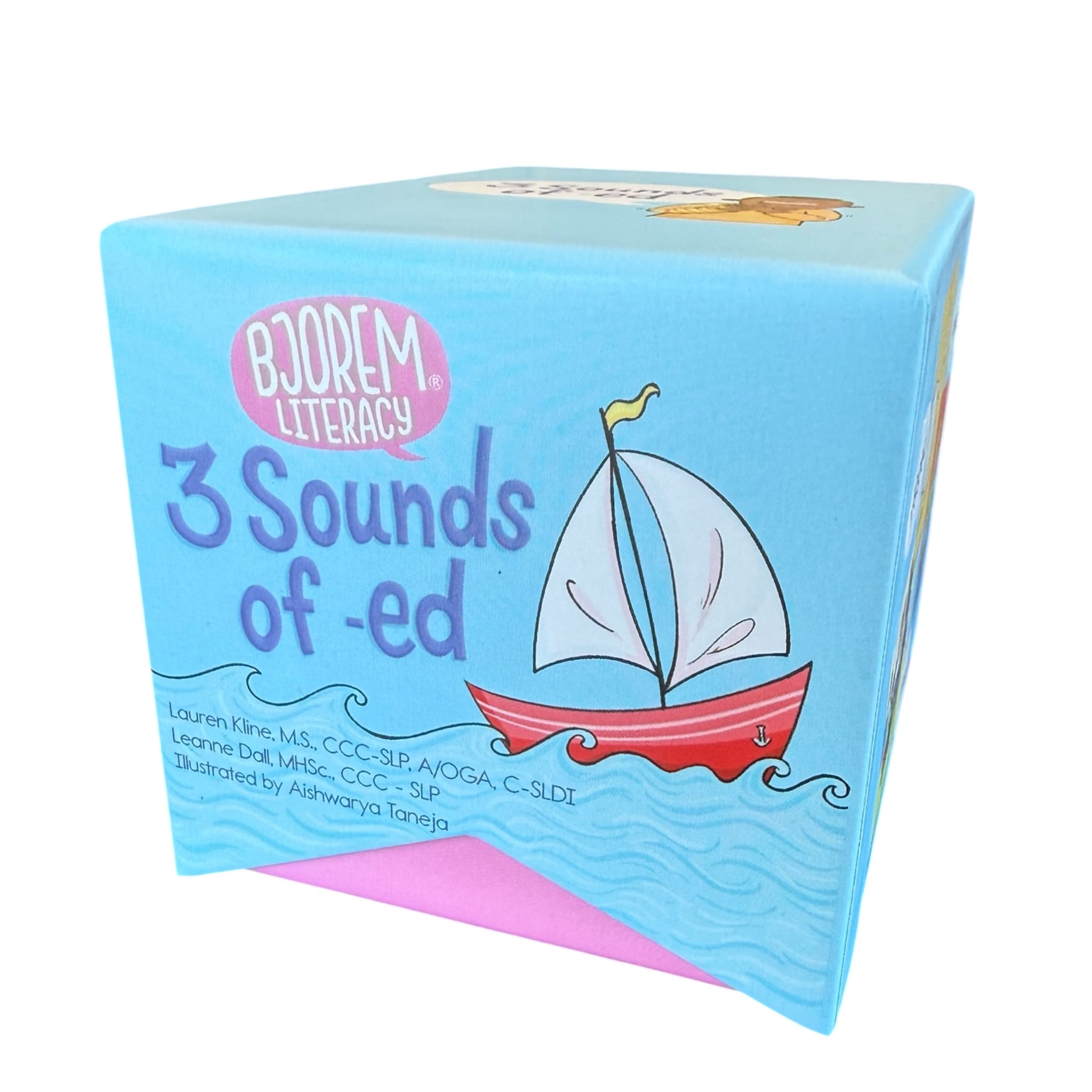
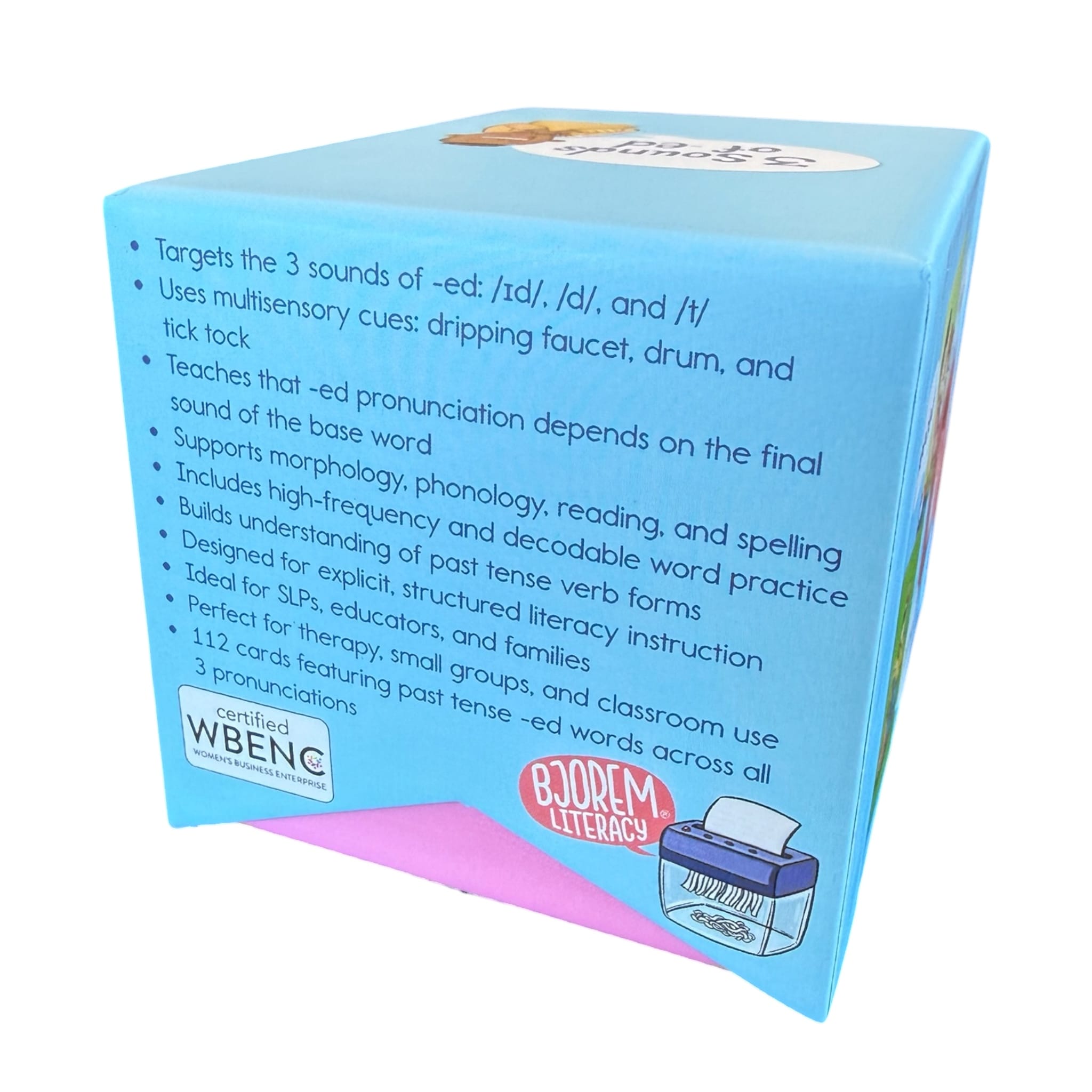
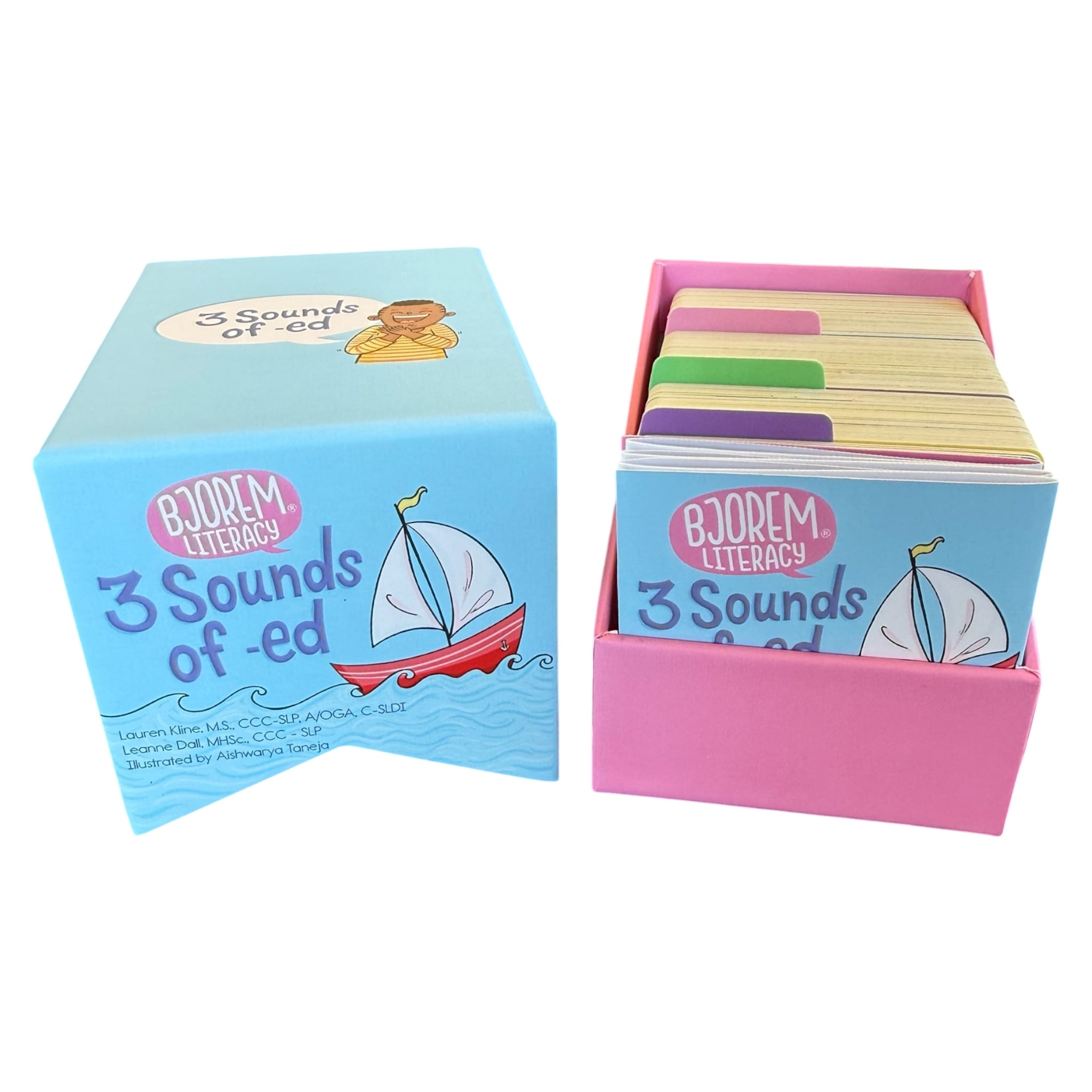
The Bjorem 3 Sounds of -ed picture cards are engaging and supply the meaning of the target words, activating the semantic network.
1. Sort -ed Words by Sound and Spell Them
Give students a set of -ed words and have them sort by the sound the -ed ending makes us say: /t/, /d/, or /ɪd/. Make sure they represent the -ed sound when they spell. While this will be easier for students who already produce -ed orally, the sound cards and spellings can also support correct oral production as you work through the task.
2. Talk About Tendencies in the -ed Endings
Once sorted, guide students to notice spelling tendencies: verbs ending in a voiceless sound (like /p/ or /k/) tend to take the /t/ sound; verbs ending in a voiced sound (like /b/ or /z/) tend to take /d/; and verbs already ending in /t/ or /d/ need that extra /ɪd/ syllable to be heard. Whether or not they are already producing the -ed consistently in oral or written form, this is helping them notice a pattern.
3. Read the -ed Words Aloud
Practice reading -ed words aloud from the backs of the cards, paying attention to the sounds, reinforcing the orthography-to-phonology link in both directions.
4. Hunt for the -ed Suffix in Real Text
Send students hunting through real, connected text for -ed words. I like to pick a text from Readworks.com or something from their curriculum or book of choice. Can they highlight the words containing the -ed morpheme? List them by the sound of the morpheme? This step moves the pattern out of an isolated word list and into authentic text, real-life application.
5. Write a Summary Sentence Using an -ed Word
Finally, students use a target (-ed) word in a sentence of their own that captures the GIST of the text. The sentence should include the who, did, what. By generating the sentence, the student is using the orthography, phonology, morphology and semantics which will lead to mastery of the -ed morpheme.
Why Picture Cards Lighten the Load When You Teach the -ed Suffix
The card works as a semantic anchor. It gives an abstract sound to spelling relationship a concrete hook to attach to, which lightens the demand on working memory. Instead of holding "what does this word mean and what does it sound like and how is it spelled" all at once, the meaning is already available, freeing up capacity for the phonological and orthographic analysis that is new and effortful.
That matters more than it might sound, because there is no single reading and writing center in the brain. Learning to read and spell depends on forming connections across the temporal, occipital, parietal, and frontal lobes. Anything that reduces the load on one of those systems gives the others room to work.
Ready to Teach the Suffix -ed?
Be flexible, have fun, and keep the goal in view: linking sound, print, and meaning every time the suffix comes up. Grab the 3 Sounds of -ed deck and let us know how it goes.