
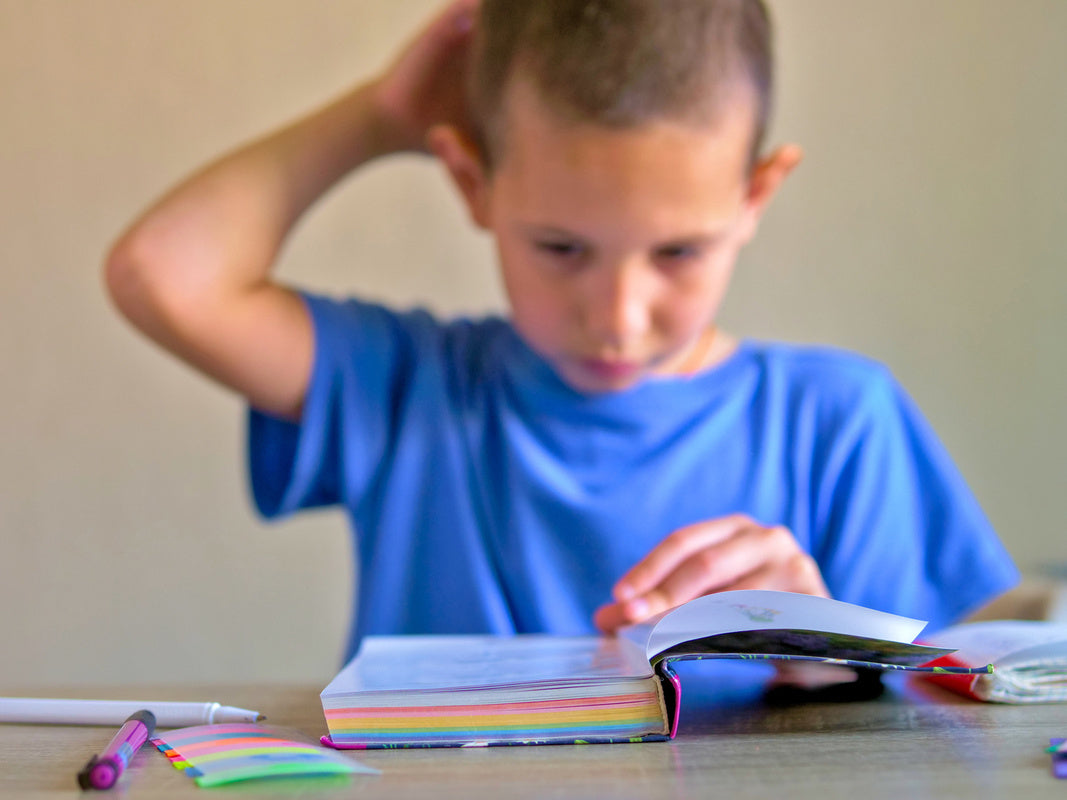
If your child comes home from school looking defeated by a picture book, we want you to know something right away: this is fixable. Reading is one of the most complex skills the human brain ever learns, and it doesn't come easily to every kid on the same timeline.
We're a team of speech-language pathologists, and figuring out how to help a child struggling with reading starts with understanding why it's so hard in the first place.
What this article covers:
How to Recognize a Struggling Reader
Before you can help, it helps to know what you're looking at. Struggling readers tend to show a cluster of these signs, not just one:
- Trouble sounding out unfamiliar words or relying heavily on guessing
- Reading that sounds choppy or unusually slow for their age
- Difficulty answering questions about what they just read
- Frequent letter reversals past the early grades
- Avoiding books or acting out when asked to read aloud
- Spelling errors that don't match how advanced their speech sounds
Keep a running note of the specific moments your child gets stuck. That list becomes gold when you're talking to a teacher or a specialist about a reading disorder down the road.
How to Help a Child With Reading Difficulties
Once you know what's going wrong, the next step is matching your approach to that specific struggle instead of guessing. Here's where we start with families:
1. Pinpoint the Real Problem First
One child might be stuck decoding letters into sounds, while another reads words fine but can't retell the story (Catts, Hogan, & Fey, 2003). Watch closely for a week or two and note exactly where the breakdown happens, then let that guide every strategy you try next.

2. Take the Pressure Off
Kids shut down fast when reading feels like a test they keep failing. Swap "sit down and read" for lower-stakes moments, like reading a comic together or listening to an audiobook. The goal isn't to lower your expectations; it's to rebuild confidence, since a reader who's terrified of the page can't learn much from it.
3. Strengthen Phonemic Awareness
Long before a child connects letters to sounds on paper, they need to hear those sounds clearly in spoken words. Activities like identifying syllables or spotting rhymes build this skill without a workbook in sight (Ehri et al., 2001).
4. Use a Multisensory Approach
Some kids need to see and physically touch a letter before it sticks. Tracing letters in sand or building words with magnetic tiles gives the brain more than one path to the same information (Schlesinger & Gray, 2017).
Our Bjorem Better Letters with the Laurie Berkner Band Card Deck was built around exactly this idea, pairing each letter sound with a song and a card kids can hold and sort themselves, turning memorizing into truly understanding.
5. Read Together, Every Single Day
Even once your child can read independently, keep reading aloud together. Take turns with a page each and talk about the story like you would with a friend. The benefits of reading with your child go well beyond literacy skills; it builds vocabulary and strengthens your relationship while signaling that books are something to enjoy, not endure (Schlesinger & Gray, 2017). Ten minutes a day is plenty.

6. Break Comprehension Into Manageable Pieces
If your child can sound out words but loses the plot along the way, the fix usually isn't more decoding practice. It's teaching them to slow down and picture what's happening, then check their own understanding. Helping kids with reading comprehension often means breaking a page into a few sentences at a time and asking a simple question after each chunk (Palincsar & Brown, 1984).
7. Watch for Underlying Speech and Language Issues
Sometimes a reading struggle isn't really about reading at all. Speech disorders in children, including trouble with sound production or delayed language development, can quietly make phonics instruction harder than it needs to be (Catts, Fey, Tomblin, & Zhang, 2002). If your child mixes up sounds when they talk or was a late talker, mention that history to whoever evaluates their reading.
If something feels off and it isn't resolving with time or extra practice, trust that instinct. Don't wait - evaluate. A speech-language pathologist can pinpoint what's happening far faster than months of trial and error at home.
8. Celebrate the Small Wins
Progress rarely looks like a straight line. Praise effort and small milestones out loud, whether that's sounding out a tricky word or finishing a page without giving up. Kids remember how reading made them feel long after they forget which words gave them trouble, which is part of why reading is important for kids well beyond any single skill they're working on (Chapman & Tunmer, 1997).

Conclusion
Helping a struggling reader takes patience, the right information, a willingness to try more than one approach, and a little faith that this stage won't last forever. Most kids who feel behind today go on to become capable, even enthusiastic, readers once their struggle is identified and addressed. You don't have to figure this out alone.
Our team builds every product with one goal in mind: giving parents, educators, and SLPs tools designed by speech therapists that turn frustration into real progress. Keep showing up for story time. Struggles like this one almost always have a happy ending.
Sources:
- Bus, A. G., Van IJzendoorn, M. H., & Pellegrini, A. D. (1995). Joint book reading makes for success in learning to read: A meta-analysis on intergenerational transmission of literacy. Review of Educational Research, 65(1), 1 to 21. https://doi.org/10.3102/00346543065001001
- Catts, H. W., Fey, M. E., Tomblin, J. B., & Zhang, X. (2002). A longitudinal investigation of reading outcomes in children with language impairments. Journal of Speech, Language, and Hearing Research, 45(6), 1142 to 1157. https://pubmed.ncbi.nlm.nih.gov/12546484/
- Catts, H. W., Hogan, T. P., & Fey, M. E. (2003). Subgrouping poor readers on the basis of individual differences in reading-related abilities. Journal of Learning Disabilities, 36(2), 151 to 164. https://pubmed.ncbi.nlm.nih.gov/15493430/
- Chapman, J. W., & Tunmer, W. E. (1997). A longitudinal study of beginning reading achievement and reading self-concept. British Journal of Educational Psychology, 67(3), 279 to 291. https://pubmed.ncbi.nlm.nih.gov/9376307/
- Ehri, L. C., Nunes, S. R., Willows, D. M., Schuster, B. V., Yaghoub-Zadeh, Z., & Shanahan, T. (2001). Phonemic awareness instruction helps children learn to read: Evidence from the National Reading Panel's meta-analysis. Reading Research Quarterly, 36(3), 250 to 287. https://doi.org/10.1598/RRQ.36.3.2
- Palincsar, A. S., & Brown, A. L. (1984). Reciprocal teaching of comprehension-fostering and comprehension-monitoring activities. Cognition and Instruction, 1(2), 117 to 175. https://doi.org/10.1207/s1532690xci0102_1
- Schlesinger, N. W., & Gray, S. (2017). The impact of multisensory instruction on learning letter names and sounds, word reading, and spelling. Annals of Dyslexia, 67(3), 219 to 258. https://pubmed.ncbi.nlm.nih.gov/28255950/