
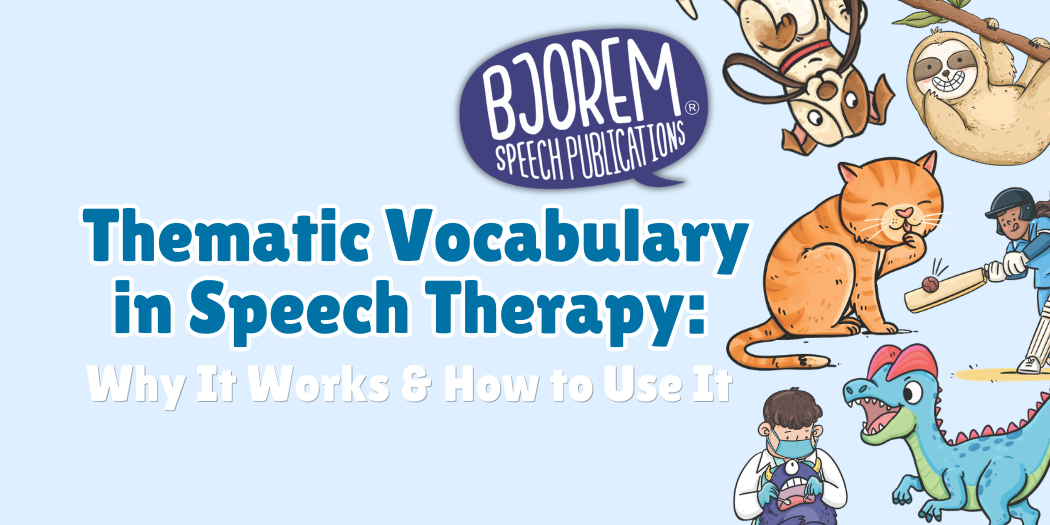
Thematic Vocabulary in Speech Therapy: Why It Works (and How to Use It)
It can be tricky (and even daunting) to work on vocabulary in speech therapy. Considering there are hundreds of thousands of words in the English language, it is not surprising that you might be unsure where to start!
Teaching isolated words like apple, jump, big can build exposure, but it doesn’t always build strong language systems (which is where the $$ is at when it comes to vocabulary instruction, especially for young children).
That’s where a thematic vocabulary approach comes in! Instead of targeting random or unrelated words, this approach guides target selection and helps you build your session around a shared (and often motivating) topic — like dogs, farm, sports, community helpers or zoo! The possibilities are endless.
This approach is fun, relevant and, perhaps best of all, evidence-based!
So, what's the deal? What is it about thematic vocabulary that makes it so effective?
Brace yourself. We're going to do a little crash course in neuroscience! Our brains store words and concepts in complex, interwoven networks (remember semantic networks from grad school?!). Words aren’t stored randomly. Our brains LOVE patterns and things that are similar or related. When we learn thematically or topically related words and concepts together, it is easier for our brains (⬆️ efficiency) and it builds stronger connections (⬆️ effectiveness), which improves overall retention and retrieval.
In short, our brains learn new words better when they are thematically related.
As an added plus... themes can be chosen based on child interests, increasing engagement. We all have a trick kid or two who doesn't care to participate... find a theme they'll like and watch the magic happen! When kids are engaged, they are learning. Centering therapy and vocabulary targets around a motivating theme can work wonders✨.
And, let's be honest.. it helps streamline planning and can be used for as long as you want (1 week, 2 weeks or even a whole month) which saves you time. We never seem to have enough of it!
So...How do I use thematic vocabulary in therapy??
Let me be clear: there is no "right or wrong" way to use thematic vocabulary. However, it is important to remember that making new words/concepts “stick and stay” requires more than just a definition (Beck & McKeown). It requires:
- Multiple exposures to the words (ideally across multiple contexts)
- Explicit instruction of the words
- Building categories
- Connecting words to themes
(Hadley et. al, 2018, Ukrainetz, 2006, Beck et. al, 2013)
Step 1: Choose a high-utility or motivating theme.
Choose a theme that is relevant (personally, academically, socially, etc.) or motivating to get a child engaged.
Step 2: Select 8–12 words.
To get the most bang for your buck, try including nouns, verbs, adjectives and/or tier 2 vocabulary.
Step 3: Go deep, not wide. Quality > Quantity.
The depth of knowledge of each word is more important than the number of words. The goal is to teach kids how to develop rich, semantic networks so they can use that framework to learn new words independently, NOT to teach them every word there is to know.
Use the same words to do multiple tasks to deepen the child understanding and concept of the word:
- Define the word
- Describe the word
- Compare the word to other words
- Act it out
- Read stories
- Make your own stories
- Identify synonyms/antonyms
- Answer WH and inferential questions

The options are endless (this list not exhaustive). Using the same vocabulary words in different activities builds stronger and more interconnected networks. When we teach vocabulary within themes, using different activities students:
- Hear words repeatedly (repetition)
- Use them in meaningful contexts (relevance)
- Connect them to prior knowledge (reflection)
That’s what makes vocabulary stick.
The Bottom Line?
Thematic vocabulary isn’t about cute decorations or seasonal units. It’s about being intentional and strategic about target selection and therapy activities so students build:
-
Stronger semantic networks
- Better word retrieval
- Deeper comprehension
-
More flexible language use
I’m all about working smarter, not harder, and utilizing thematic vocabulary in speech and language therapy does just that! Which theme(s) will you start with first??
👉Take a FREE Thematic Vocabulary Course (and get 1 PDH upon course completion!)
References
-
Beck, I. L., McKeown, M. G., & Kucan, L. (2013). Bringing words to life: Robust vocabulary instruction (2nd ed.). Guilford Press.
-
Hadley, E.B., Dickinson, D.K., Hirsch-Pasek, K., & Golinkoff, R.M. (2018). Building semantic networks: The impact of a vocabulary intervention on preschoolers' depth of word knowledge. Reading Research Quarterly. Advance online publication. doi: 10.1002/rrq.225
-
Ukrainetz, T. A. (2006). Contextualized language intervention: Scaffolding prek-12 literacy achievement ; teaching students with language impairments the language needed for academic success through scaffolding explicit skills in purposeful contexts. Pro ed.