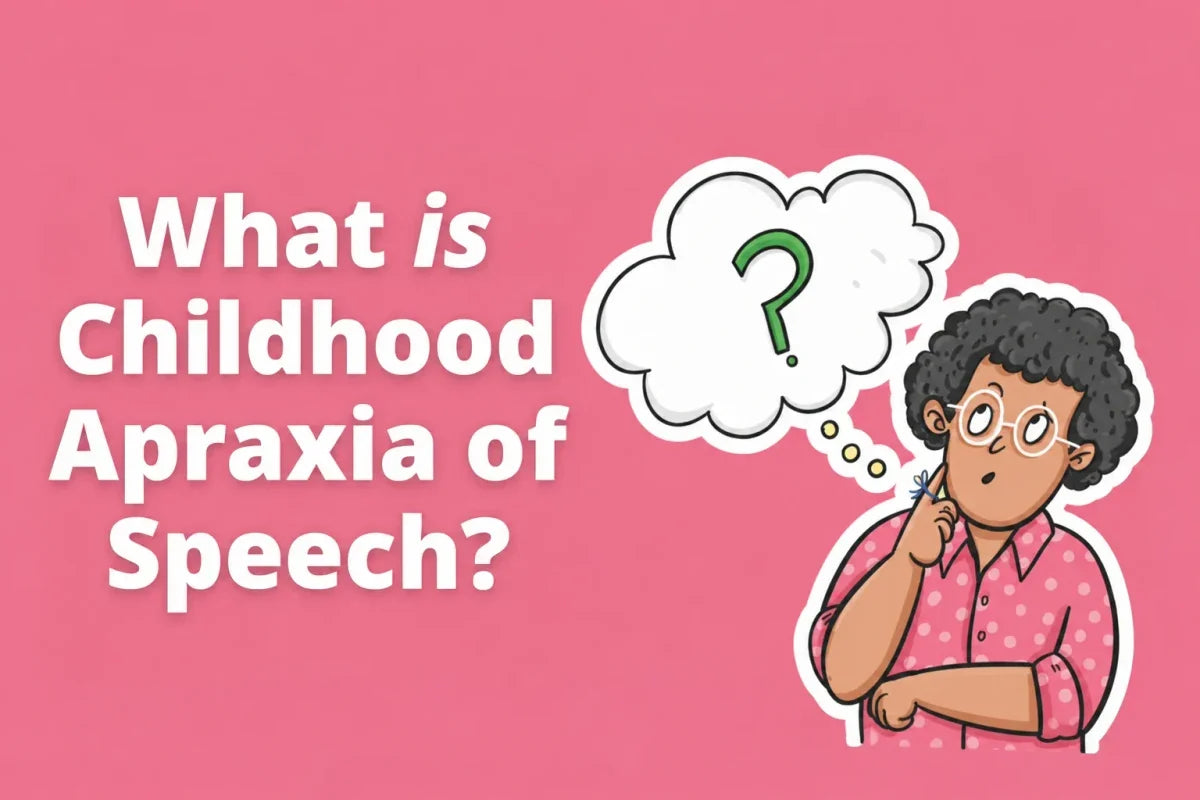

Childhood apraxia of speech (CAS, trouble planning the movements for speech) is rare. It affects about 1 in 1,000 children aged 4 to 8 (Shriberg, Kwiatkowski, & Mabie, 2019).
If your child’s speech-language pathologist (SLP) has just mentioned CAS, the word “rare” can make you feel like the only family going through this. You’re definitely not! Let’s look at what the numbers mean for your child, and what we recommend doing with them.
How Common Is Apraxia of Speech in Children?
About 1 in 1,000 children aged 4 to 8 have CAS at any one time. That’s 0.1%, which we like to picture as about one child in a school of 1,000 young kids.
To find this number, researchers studied speech samples from 415 children in six US cities who had idiopathic speech delay (a speech delay with no known cause). They then combined the results with how common speech delay is in Australia, England, and the USA (Shriberg, Kwiatkowski, & Mabie, 2019).

Why Some Groups of Children Have Higher Rates of CAS
Genes are one of the known possible causes of apraxia, and many of the genes linked to CAS are also linked to other conditions that affect how the brain develops (Morgan et al., 2024). This overlap helps explain why rates of CAS are higher in children who have some of those conditions. Here’s how rates of CAS compare across the groups that have been studied:
| Group | Estimated Rate of CAS | What It Means for Your Child |
|---|---|---|
| All children aged 4 to 8 | About 1 in 1,000 | For most children, CAS is unlikely, but only an evaluation can tell you for sure. |
| Children with a speech delay that has no known cause | 2.4%, or about 24 in 1,000 (Shriberg, Kwiatkowski, & Mabie, 2019) | Most children with a speech delay don’t have CAS, but your SLP can check whether yours does. |
| People with complex neurodevelopmental conditions (conditions that affect how the brain develops), like Down syndrome or 22q11.2 deletion syndrome (a missing piece of chromosome 22) | 4.3% have CAS, and another 4.9% have CAS along with dysarthria (weak or poorly controlled speech muscles) (Shriberg, Strand, Jakielski, & Mabie, 2019) | CAS is more likely, so we recommend asking your SLP to check for it by name. |
| Autistic children | Not known yet. Reported rates vary a lot between studies, partly because studies diagnose autism and CAS in different ways. | Some autistic children have trouble planning speech movements, so we recommend asking your SLP to check. |

Why CAS Can Be Tricky to Diagnose
CAS shares some signs with two other motor speech disorders (conditions that make speech movements hard to plan or control). These are dysarthria and speech motor delay (motor speech difficulties that don’t fit CAS or dysarthria). If an evaluation only looks for CAS, a child with one of these can be diagnosed with CAS by mistake, or their motor speech disorder can be missed altogether. Dysarthria often gets overlooked because many SLPs don’t feel confident diagnosing it in children (Iuzzini-Seigel, Allison, & Stoeckel, 2022).
A child who is very hard to understand doesn’t automatically have CAS, either. Diagnosing CAS based only on how severe a child’s speech difficulty is can lead to overdiagnosis (diagnosing kids with CAS when they don’t have it). That’s because most children with a speech delay don’t have a motor speech disorder at all. In one study, more than 4 in 5 of them had none (Shriberg, Kwiatkowski, & Mabie, 2019).
Here’s what we recommend for parents and SLPs:
- If you’re a parent: Ask your SLP which motor speech disorders they checked for, and how they ruled each one in or out. It’s always okay to ask, and you’ll understand your child’s diagnosis better once you hear the answers.
- If you’re an SLP: We recommend assessing for CAS and dysarthria together, across several speech tasks, and considering speech motor delay when a child doesn’t meet the criteria for either. When CAS is one of the possibilities, you can use an apraxia screener to spot children who show signs of CAS, so you know who needs a full evaluation.
Assessing CAS well takes training and practice. That’s why, through our nonprofit partnership, the Bjorem & Bolles Apraxia Education Initiative, we train SLPs around the world to confidently assess and treat CAS.

Rare Doesn’t Mean That You're Alone
You’re not on your own with this! Even though CAS is rare, plenty of SLPs know it well and can support your family through therapy. Many parents also find it helps to connect with other families of children with CAS, through local or online parent groups. Two places to start are Bjorem & Bolles, our nonprofit apraxia education initiative with a free network of therapists, and The Apraxia Foundation, a nonprofit that helps families of children with CAS afford speech services and AAC. We love seeing families support each other like this, because other parents who’ve been there often understand what you’re going through like no one else can.
An evaluation tells you whether your child has CAS or a different speech difficulty, so they can start the right apraxia treatment. Once therapy starts, your SLP can show you how to use apraxia cards at home, so you can keep practicing between sessions. However rare CAS is, if something about your child’s speech is on your mind, even if they’re still a toddler, don’t wait - evaluate.
Frequently asked questions
Is apraxia of speech more common in boys?
CAS affects both boys and girls, but there appear to be higher rates of CAS in boys.
Are other motor speech disorders as rare as CAS?
Some are, and some aren’t. Childhood dysarthria is just as rare as CAS, at about 1 in 1,000 children aged 4 to 8, while speech motor delay is more common, at about 4 in 1,000 (Shriberg, Kwiatkowski, & Mabie, 2019).
If CAS is so rare, why did my SLP bring it up?
Your SLP brings up CAS when they hear something in your child’s speech that can be a sign of it. Mentioning it doesn’t mean your child has CAS. We recommend asking what they noticed, and whether they plan to do a full motor speech evaluation to check.
If CAS is rare, could my child’s diagnosis be wrong?
An SLP is the best person to answer that question. A second opinion is always okay, too! Look for one who works with lots of children with CAS, and bring the reports from your child’s first evaluation so they can see what was already checked.
Sources:
- Iuzzini-Seigel, J., Allison, K. M., & Stoeckel, R. (2022). A tool for differential diagnosis of childhood apraxia of speech and dysarthria in children: A tutorial. Language, Speech, and Hearing Services in Schools, 53(4), 926 to 946. https://doi.org/10.1044/2022_LSHSS-21-00164
- Morgan, A. T., Amor, D. J., St John, M. D., Scheffer, I. E., & Hildebrand, M. S. (2024). Genetic architecture of childhood speech disorder: A review. Molecular Psychiatry, 29(5), 1281 to 1292. https://doi.org/10.1038/s41380-024-02409-8
- Shriberg, L. D., Kwiatkowski, J., & Mabie, H. L. (2019). Estimates of the prevalence of motor speech disorders in children with idiopathic speech delay. Clinical Linguistics & Phonetics, 33(8), 679 to 706. https://doi.org/10.1080/02699206.2019.1595731
- Shriberg, L. D., Strand, E. A., Jakielski, K. J., & Mabie, H. L. (2019). Estimates of the prevalence of speech and motor speech disorders in persons with complex neurodevelopmental disorders. Clinical Linguistics & Phonetics, 33(8), 707 to 736. https://doi.org/10.1080/02699206.2019.1595732