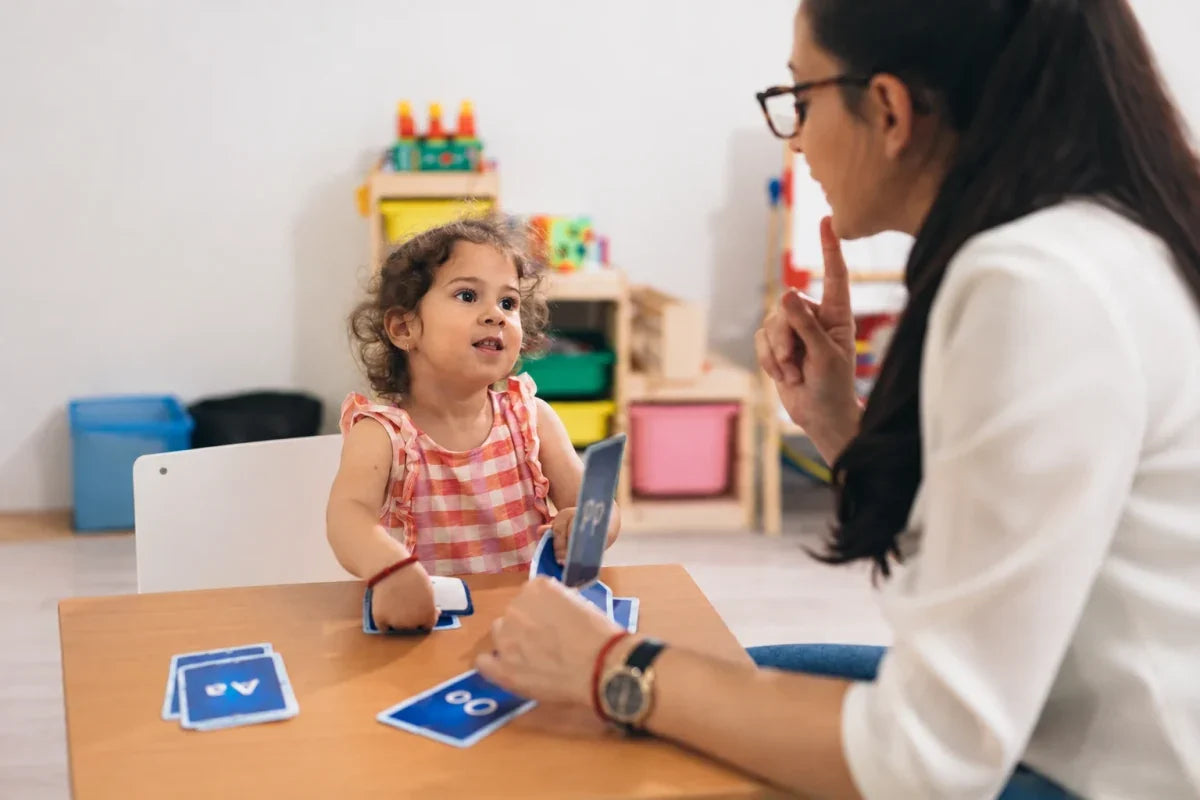
There are two main types of apraxia of speech, acquired apraxia of speech (AOS) and childhood apraxia of speech (CAS). In both, the brain has trouble planning the movements for speech, but the two have different causes (Allison, Cordella, Iuzzini-Seigel, & Green, 2020).
If “apraxia” is a brand-new word in your house, that’s okay! CAS is something we specialize in at Bjorem Publications, so that’s where we’ll spend most of our time. By the end, you’ll know which questions to bring to your child’s next appointment with a speech-language pathologist (SLP).
The Two Main Types of Apraxia of Speech
With either type of apraxia of speech, the speech muscles themselves work. Your child’s lips, tongue, and jaw can move, but apraxia makes it much harder for their brain to put those movements in the right order (Chenausky & Tager-Flusberg, 2022). Where the two types differ is when that difficulty starts and why.
Acquired Apraxia of Speech
Acquired apraxia of speech happens when an illness or injury damages the parts of the brain that plan speech. A person with acquired AOS loses speech skills they already had. While it’s most common in adults, often following a stroke (Knollman-Porter, 2008), acquired AOS can affect someone at any age, including children (American Speech-Language-Hearing Association [ASHA], n.d.; De Witte et al., 2017).

Childhood Apraxia of Speech (CAS)
CAS shows up while a child is learning to talk. Many children with CAS don’t have a known cause. Others have CAS alongside a neurological or developmental condition (Shriberg, Strand, Jakielski, & Mabie, 2019), and new genetic causes of CAS are being identified every year (Morgan et al., 2024).
CAS is also an umbrella name for any apraxia of speech that appears in childhood, including apraxia that follows an early stroke, an infection, a head injury, or surgery to remove a brain tumor.
That’s where the two types overlap. If your child lost speech skills after an illness or injury, you can hear their apraxia called either CAS or acquired AOS. Acquired AOS describes how it started, with your child losing skills they’d already learned. CAS is the name for any apraxia of speech in a child, whatever the cause. If you hear both, ask the speech-language pathologist who diagnoses your child which name they’re using and why. That way, you can make sense of their reports and look for the right kind of support.

Related Conditions That Aren't Types of Speech Apraxia
A few other “apraxia” words can come up at your child’s appointments. They affect movements other than speech, so let’s sort them out:
- Oral apraxia: Also called orofacial or buccofacial apraxia, it makes face movements on request tricky, like licking the lips, sticking out the tongue, or whistling.
- Limb apraxia: Planned arm and leg movements are hard to do on request.
Researchers have found both alongside CAS (Chenausky et al., 2023). Neither one is a type of speech apraxia, though, because neither affects the plan for speech.
If you’re keeping track of every name you’ve heard, here’s how the two types of apraxia of speech compare with these look-alikes:
| Condition | What It Affects | Who It Usually Affects | A Type of Speech Apraxia? |
|---|---|---|---|
| Childhood apraxia of speech (CAS) | Planning and sequencing speech movements | Children during speech development | Yes |
| Acquired apraxia of speech | Planning and sequencing speech movements after brain damage | Most often adults, sometimes children | Yes |
| Oral (orofacial) apraxia | Requested non-speech face movements | Can occur with or without CAS | No |
| Limb apraxia | Planned movements of the limbs | Can occur with or without CAS | No |

Questions to Ask Your SLP About Your Child’s Type of Apraxia
When you know the type of apraxia your child has, you’ll have a clearer idea of what therapy will look like. We suggest taking these two questions to your child’s next SLP appointment:
- “Which type of apraxia of speech does my child have?” From the answer, you’ll know where therapy starts. A child with acquired AOS is working to get back speech skills they had before. A child with CAS is learning to plan speech movements for the first time.
- “What will practice look like for my child?” Many of the CAS treatments that have been studied work directly on speech motor skills, so your child gets lots of chances to plan and say target words (Murray, McCabe, & Ballard, 2014). Your SLP will choose from the apraxia treatments that fit your child. The apraxia cards we make are designed by SLPs for this kind of repeated practice, so your SLP can pick targets that match your child’s goals.
With those answers, you’ll know how your child’s therapy plan connects to the type of apraxia they have. And if your child hasn’t had an evaluation yet, don’t wait - evaluate.
Frequently asked questions
Is apraxia of speech the same as aphasia?
Not quite. Aphasia is a language disorder, so it affects finding and understanding words. Apraxia of speech affects planning the movements to say them, and the two can happen together after a brain injury or brain surgery (De Witte et al., 2017).
My child can’t whistle or stick out their tongue on request. Does that mean CAS?
Not on its own. Trouble with face movements on request is a sign of oral apraxia, which doesn’t affect the plan for speech. Mention it to your SLP, since it’s a helpful clue during an evaluation.
Does CAS turn into acquired apraxia when my child grows up?
It stays CAS as your child grows, and speech differences from CAS can continue into the teen years and even adulthood (Cassar, McCabe, & Cumming, 2023). Acquired apraxia comes from damage to a brain that had already learned to talk, so it’s a separate diagnosis (Allison et al., 2020).
Is “verbal apraxia” a different type from CAS?
It’s the same condition with an older name! Developmental apraxia of speech and developmental verbal dyspraxia are older terms for what’s now called childhood apraxia of speech (ASHA, n.d.). If you spot one of them in an older article or report, it refers to CAS.
Sources:
- Allison, K. M., Cordella, C., Iuzzini-Seigel, J., & Green, J. R. (2020). Differential diagnosis of apraxia of speech in children and adults: A scoping review. Journal of Speech, Language, and Hearing Research, 63(9), 2952 to 2994. https://doi.org/10.1044/2020_JSLHR-20-00061
- American Speech-Language-Hearing Association. (n.d.). Childhood apraxia of speech [Practice Portal]. Retrieved November 21, 2026, from https://www.asha.org/practice-portal/clinical-topics/childhood-apraxia-of-speech/
- Cassar, C., McCabe, P., & Cumming, S. (2023). “I still have issues with pronunciation of words”: A mixed methods investigation of the psychosocial and speech effects of childhood apraxia of speech in adults. International Journal of Speech-Language Pathology, 25(2), 193 to 205. https://doi.org/10.1080/17549507.2021.2018496
- Chenausky, K. V., Baas, B., Stoeckel, R., Brown, T., Green, J. R., Runke, C., Schimmenti, L., & Clark, H. (2023). Comorbidity and severity in childhood apraxia of speech: A retrospective chart review. Journal of Speech, Language, and Hearing Research, 66(3), 791 to 803. https://doi.org/10.1044/2022_JSLHR-22-00436
- Chenausky, K. V., & Tager-Flusberg, H. (2022). The importance of deep speech phenotyping for neurodevelopmental and genetic disorders: A conceptual review. Journal of Neurodevelopmental Disorders, 14(1), Article 36. https://doi.org/10.1186/s11689-022-09443-z
- De Witte, E., Wilssens, I., De Surgeloose, D., Dua, G., Moens, M., Verhoeven, J., Manto, M., & Mariën, P. (2017). Apraxia of speech and cerebellar mutism syndrome: A case report. Cerebellum & Ataxias, 4, Article 2. https://doi.org/10.1186/s40673-016-0059-x
- Knollman-Porter, K. (2008). Acquired apraxia of speech: A review. Topics in Stroke Rehabilitation, 15(5), 484 to 493. https://doi.org/10.1310/tsr1505-484
- Morgan, A. T., Amor, D. J., St John, M. D., Scheffer, I. E., & Hildebrand, M. S. (2024). Genetic architecture of childhood speech disorder: A review. Molecular Psychiatry, 29(5), 1281 to 1292. https://doi.org/10.1038/s41380-024-02409-8
- Murray, E., McCabe, P., & Ballard, K. J. (2014). A systematic review of treatment outcomes for children with childhood apraxia of speech. American Journal of Speech-Language Pathology, 23(3), 486 to 504. https://doi.org/10.1044/2014_AJSLP-13-0035
- Shriberg, L. D., Strand, E. A., Jakielski, K. J., & Mabie, H. L. (2019). Estimates of the prevalence of speech and motor speech disorders in persons with complex neurodevelopmental disorders. Clinical Linguistics & Phonetics, 33(8), 707 to 736. https://doi.org/10.1080/02699206.2019.1595732