
When people ask me about the best speech therapy toys, my answer is probably not what they expect.
Some of my favorite therapy toys are not toys at all.
Give me a roll of blue painter’s tape, a stack of Dixie cups, a few little animals, some books, and a deck of Bjorem cards, and I can build an entire therapy session around them.
As speech therapists, we don’t need a closet full of expensive toys to create great therapy. We need flexible materials, a clear target, and enough creativity to turn play into meaningful practice.
After years of working with children, I have learned that the best therapy materials are not necessarily the most expensive, complicated, or flashy. I want materials that are flexible. I want something I can use for speech sounds, language, motor speech, environmental sounds, high repetitions, movement, and play.
Most importantly, I want the child to be engaged.
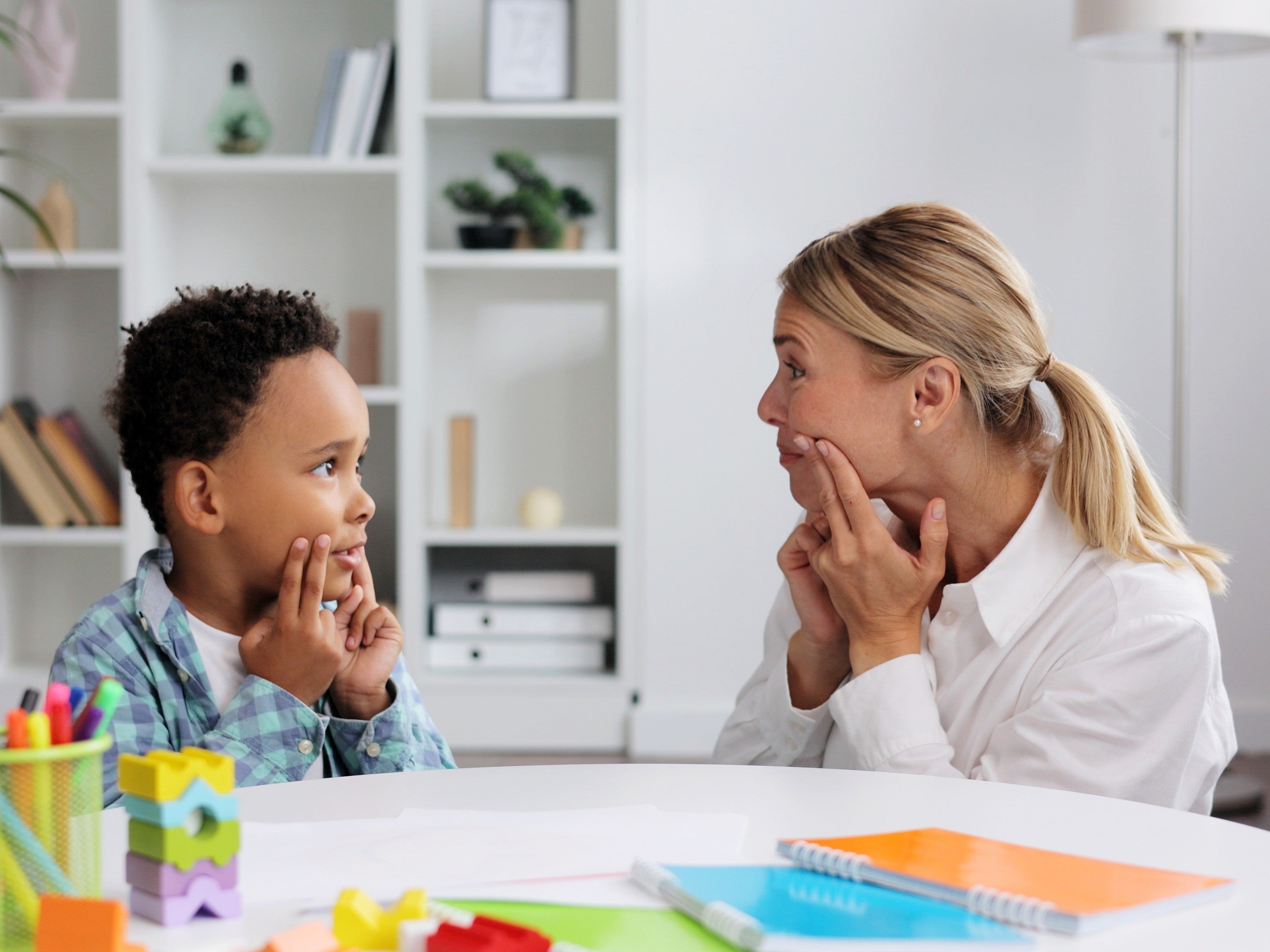
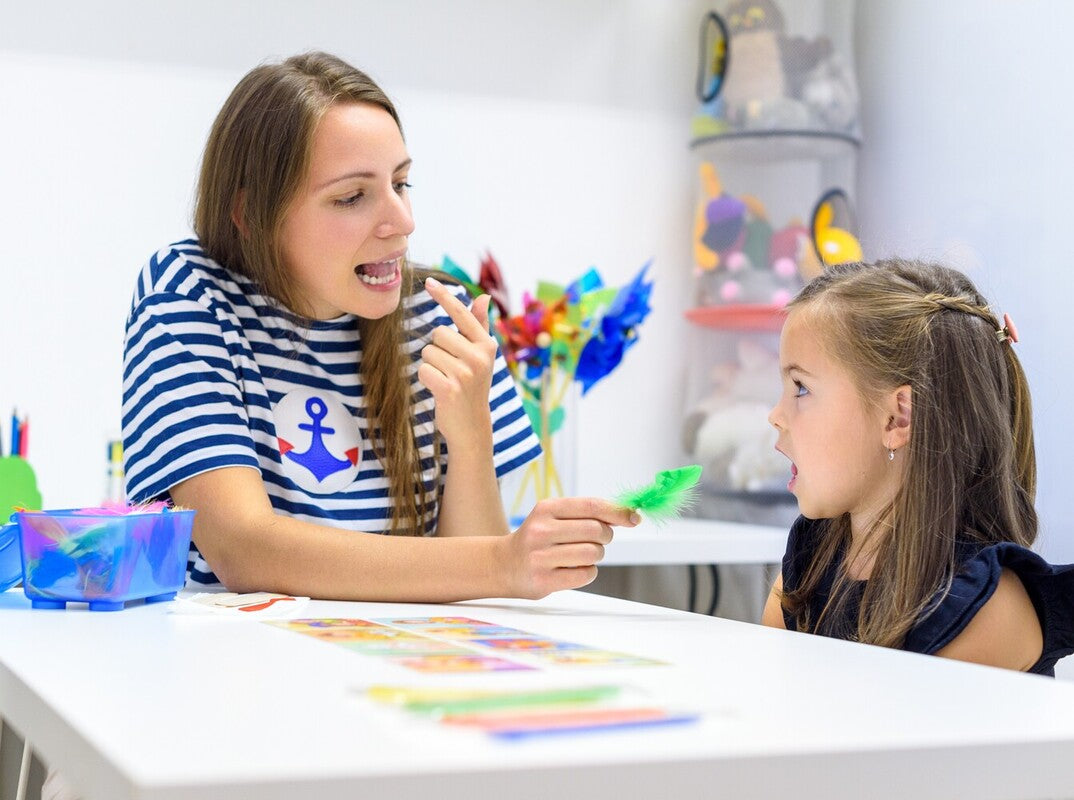
Research on play and language development supports something speech therapists already see every day: the toy itself is not doing the teaching. The interaction between the child and the adult is what creates opportunities for communication and learning (Weisberg et al., 2013; Sosa, 2016).
Here are seven of my absolute favorite things to use in speech therapy and all the ways you can use them:
1. Blue Painter’s Tape
Yes. Blue tape.
If you have ever watched me do therapy, you know how much I love painter’s tape because you can turn it into almost anything.
One of my favorite games is Tape Up. The child practices a target from a Bjorem card, then gets to tape the card somewhere on the wall. Practice another target. Tape up another card. Suddenly you have taken repetitions that could have felt like work and turned them into a game.
Another favorite is Animal Rescue.
Tape little animals to the wall, underneath a table, on the side of a cabinet, or anywhere the child can safely reach. Give the child a basket and tell them the animals need to be rescued.
Before rescuing each animal, you might practice a target word, elicit an animal or environmental sound, practice a speech sound, use a stimulability approach to explore a new sound, or practice a short phrase.
Then rescue the animal and get it to safety.
Need more movement?
Make an obstacle course on the floor with blue tape. Create it together. Walk, jump, crawl, or balance along the lines while practicing speech or language targets throughout the activity.
And don’t forget clean-up. Making the obstacle course, playing on it, and cleaning it up are all opportunities for language and speech practice.
You can even tape little animals, bugs, or people onto toy cars like seat belts and race them around the room.
A roll of painter’s tape costs almost nothing, and I could use it in therapy every single day.

2. Dixie Cups
Dixie cups may be one of the most underrated speech therapy materials ever.
Buy a big stack and see what happens.
Kids can earn cups for completing accurate repetitions of a target. Once they have enough, stack them into towers or pyramids and knock them down.
You can also hide gems or minis underneath them, tape Bjorem cards to the top, tape little objects inside them, turn them sideways into animal houses, tape them to a wall to make cubbies, sort objects into them, or stomp on them at the end.
Kids LOVE stomping on them.
If you are working on motor speech or articulation and need a high number of accurate repetitions, materials with many pieces can be incredibly useful because every piece creates another opportunity to practice.
The key word is accurate. We are not just chasing a big number. We want lots of successful, intentional practice.
3. Books
I love books.
Books are one of the easiest ways to bring speech, language, literacy, prediction, and interaction together in one activity.
And you don’t have to sit down and read every word on every page.
Make the book interactive.
Find little objects, minis, pictures, or Bjorem cards that match things happening in the story. Let the child hold them, find them, match them, hide them, or act out what is happening.
Highly repetitive books are especially fun because children begin to predict what is coming next.
When a child knows the repeated line, you can pause before the predictable word and give them an opportunity to participate.
Books such as Oh No Pee-Pee or Oh No Poo-Poo give you repeated opportunities for playful speech practice. You can pair the sounds and words in the book with Bjorem Speech Sound Cues when appropriate to help facilitate productions.
Repeated reading also supports vocabulary and oral language development, and shared book reading gives adults repeated opportunities to talk about words, ideas, characters, and events with children (Mol & Bus, 2011).
The goal is not to quiz the child about the book.
Play with the book.

4. Animals and Little People
Give me a handful of little animals or people, and I have a therapy session.
You can use them with a farm, dollhouse, blocks, Magna-Tiles, cars, Dixie cups, blue tape, or nothing else at all.
Animals are especially wonderful for early speech because they open the door to environmental sounds.
Moo.
Baa.
Neigh.
Woof.
Beep.
Crash.
Uh-oh.
Environmental sounds are playful, meaningful, and often easier for young children to imitate than adult-selected words.
If thinking of environmental sounds does not come naturally to you, the Bjorem What Sound? Deck can give speech therapists and families ideas that can then be carried directly into play.
One of my favorite animal activities is ridiculously simple.
-
Take a square of toilet paper and turn it into a blanket.
-
Put the animals to sleep.
-
“Night-night.”
-
Cover them up.
-
Then wake them up.
-
“Wake up!”
-
Take the blankets off.
-
Put them back to sleep.
Kids will do this over and over, which means you have naturally created repetition without turning play into a drill.
With little people and animals, you can also work on verbs, directions, spatial concepts, pretend play, sequencing, and early phrases.

5. Games With Lots of Parts or Numbers
If I am choosing a therapy game, I love a game with lots of pieces.
Why?
Lots of pieces can create lots of opportunities for practice.
That is especially helpful when I need high repetitions for speech motor learning. Principles of motor learning emphasize the importance of practice conditions and sufficient opportunities for successful practice (Maas et al., 2008).
One of my favorites is our ring toss therapy toy.
It comes with lots of brightly colored rings, but you do not have to play it as a traditional ring toss.
You could practice a target and collect a ring, put a ring underneath a Bjorem card, sort rings by color, assign numbers to different colors, roll a die and practice that many times, build the ring tower, or tape the rings to the wall with blue tape.
I also created Roll & Pop because some children LOVE numbers, dice, competition, and knowing exactly how many turns they get.
Another favorite is Can of Worms. Spin the can, pull out a worm, measure it, and let the number determine how many times you practice the target.
Kids love it because the number of repetitions becomes part of the game.
Other games I love include Bunny Hop and Pop the Pig because they have repeated turns and lots of opportunities to practice.
The game does not have to be “speech therapy.” You make it speech therapy by knowing what you want to practice.

6. Magna-Tiles and Blocks
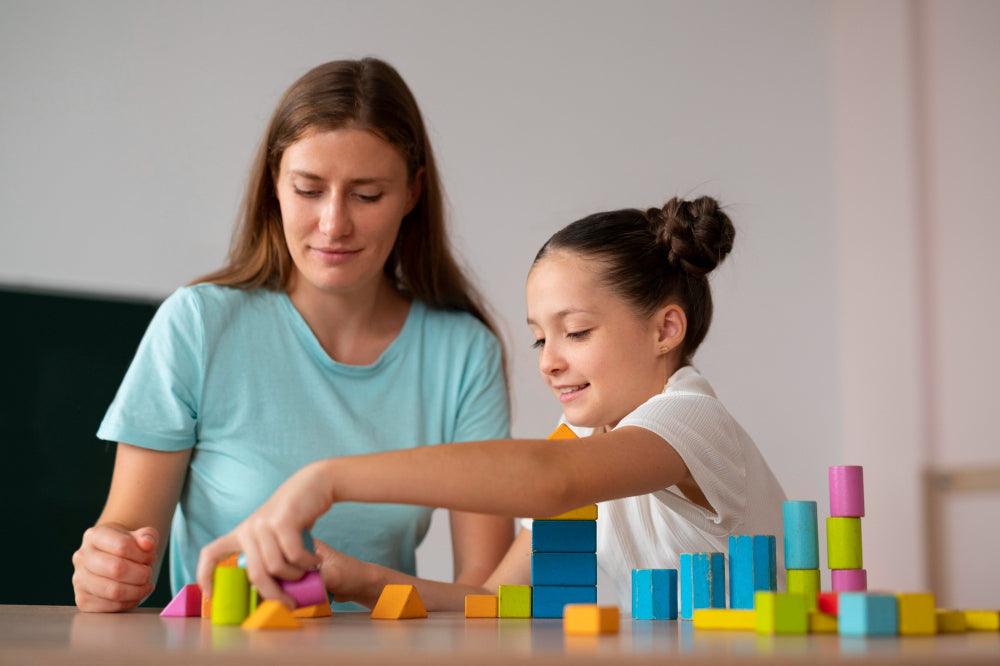
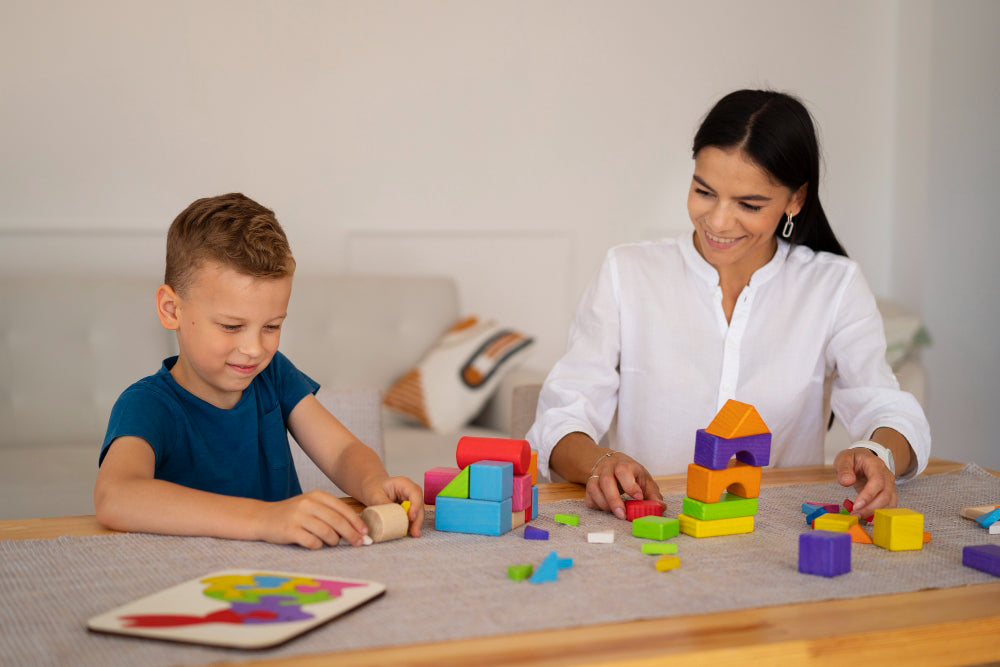
Blocks and Magna-Tiles are always in my therapy rotation because they are completely open-ended.
Build something.
Knock it down.
Build it again.
Talk about what you are making.
And here’s one of my favorite tricks:
Bjorem cards fit right inside Magna-Tile squares.
Now your speech or language target is literally embedded into the structure you are building.
Practice the target and add another tile. Practice again and build another level.
You can also hide cards inside structures, build houses around them, sort them, or assign different targets to different colors.
Block play is also a wonderful setting for spatial language such as above, below, beside, between, on, and under. Research has shown that guided block play can create rich opportunities for adults to use spatial language with children (Ferrara et al., 2011).
And while we’re talking about magnets, put small round magnets underneath Bjorem cards and let the child pick them up with a magnetic wand after practicing the target.
MAGIC.
Kids love it.
7. Minis
Minis are always a hit.
Tiny animals. Tiny foods. Tiny household objects. Tiny people. Tiny everything.
Kids love finding them, sorting them, collecting them, hiding them, and matching them.
You can hide minis around the room, tape them to the wall, put them underneath Dixie cups, sort them, match them, put them into sensory bins, pair them with books, put them inside Magna-Tile structures, or use them with Bjorem cards.
Our Sound Cue Minis are especially fun because they give children a tangible object to pair with speech sound cues. They can be hidden, collected, matched, taped up, or incorporated into play while you work on speech targets.
I also love using the spatial concepts card deck and minis bundle because the child can physically move the minis while practicing concepts such as under, beside, between, behind, and on top. Instead of only looking at a picture, they get to act out the concept.
We have several different mini options at Bjorem Speech, and we are also releasing retired Speech Tree Co. themes quarterly, for example, the Comprehensive Pet Themed Language Unit, which gives you even more ways to rotate materials and keep play fresh.
One important note: minis are small. Always consider the child’s age and development and provide appropriate adult supervision because small objects can be a choking hazard.

Bonus: Bjorem Monster Mouth Model
This one deserves a bonus spot because it is part teaching tool and part therapy room decor.
The Bjorem Monster Mouth Model lets children see the mouth on a much bigger scale.
Speech movements can be hard to understand because so much of what is happening is hidden inside the mouth. A large mouth model gives speech therapists a way to show children what the tongue, lips, jaw, and teeth are doing in a way that is much easier to see.
You can use it when teaching speech sound placement, demonstrating movements, comparing different tongue positions, or simply helping a child understand what you mean when you talk about what is happening inside their mouth.
And when you are not using it?
It looks pretty great sitting in a speech therapy room.
What Actually Makes Something a Good Speech Therapy Toy?
Notice what most of my favorites have in common.
They are open-ended.
A child does not push one button and watch the toy do all the work.
The child has to do something with the material.
Build.
Hide.
Find.
Rescue.
Stack.
Knock down.
Pretend.
Ask.
Choose.
Move.
Talk.
That interaction is where so much of the learning happens.
Research comparing different toy types has also found that traditional toys and books can support richer parent-infant communication than electronic toys that do more of the talking and entertaining for the child (Sosa, 2016).
So when you are choosing the best speech therapy toys, I would worry less about whether something is marketed for speech therapy and ask yourself:
How many different things can I do with this?
If you can think of five, ten, or twenty different ways to use it, you probably have a winner.

Do I Need Special Speech Therapy Toys at Home?
No. Parents sometimes think they need to recreate a speech therapy clinic in their living room.
You don’t.
Look around your house.
You probably already have books, blocks, cars, little animals, cups, tape, containers, stuffed animals, and other things your child loves.
Follow your child’s interests and use what motivates them.
If your child loves dinosaurs, use dinosaurs.
If they love cars, use cars.
If they want to tape twenty plastic bugs underneath the kitchen table and rescue them one by one, congratulations. You have a therapy activity.
The toy is the vehicle.
The interaction is the intervention.
How Many Speech Therapy Toys Do I Need?
Fewer than you think.
I would rather have five materials I can use twenty different ways than twenty toys I can only use one way.
Rotate what you have. Combine materials. Put the animals with the Magna-Tiles. Put the Bjorem cards under the Dixie cups. Tape the minis to the wall. Put the rings underneath your target cards.
Some of the best sessions happen when speech therapists combine two completely unrelated materials and let the child help decide what happens next.
How Often Should We Practice at Home?
Home practice should support what is happening in therapy, not become another job for the child or family.
If a speech-language pathologist has given you specific targets to practice, ask them to show you exactly how they want you to practice them.
For motor speech work in particular, accurate practice matters. I want the child to have a successful motor plan and the caregiver to understand the cues before we start asking for lots of repetitions at home.
Short opportunities can then be worked naturally into play and everyday routines.

Conclusion
The best speech therapy toys are not necessarily speech therapy toys at all.
They are materials that help you create interaction, movement, imagination, language, and lots of opportunities for successful practice.
Give me blue tape.
Give me Dixie cups.
Give me animals, books, Magna-Tiles, minis, and a game with a ridiculous number of pieces.
That’s my kind of therapy closet.
Speech therapists do not need the newest or flashiest toy to create great therapy. We need speech therapy toys that help us connect with the child, follow their interests, and build meaningful practice into play.
Get down on the floor, follow what they love, and figure out how to weave your target into the play.
That is where the magic happens.
Sources:
-
Ferrara, K., Hirsh-Pasek, K., Newcombe, N. S., Golinkoff, R. M., & Lam, W. S. (2011). Block talk: Spatial language during block play. Mind, Brain, and Education, 5(3), 143–151. https://doi.org/10.1111/j.1751-228X.2011.01122.x
-
Maas, E., Robin, D. A., Austermann Hula, S. N., Freedman, S. E., Wulf, G., Ballard, K. J., & Schmidt, R. A. (2008). Principles of motor learning in treatment of motor speech disorders. American Journal of Speech-Language Pathology, 17(3), 277–298. https://doi.org/10.1044/1058-0360(2008/025)
-
Mol, S. E., & Bus, A. G. (2011). To read or not to read: A meta-analysis of print exposure from infancy to early adulthood. Psychological Bulletin, 137(2), 267–296. https://doi.org/10.1037/a0021890
-
Sosa, A. V. (2016). Association of the type of toy used during play with the quantity and quality of parent-infant communication. JAMA Pediatrics, 170(2), 132–137. https://doi.org/10.1001/jamapediatrics.2015.3753
-
Weisberg, D. S., Zosh, J. M., Hirsh-Pasek, K., & Golinkoff, R. M. (2013). Talking it up: Play, language development, and the role of adult support. American Journal of Play, 6(1), 39–54.