Before They Can Tie Their Shoes: Teaching Growth Mindset from the Very Start
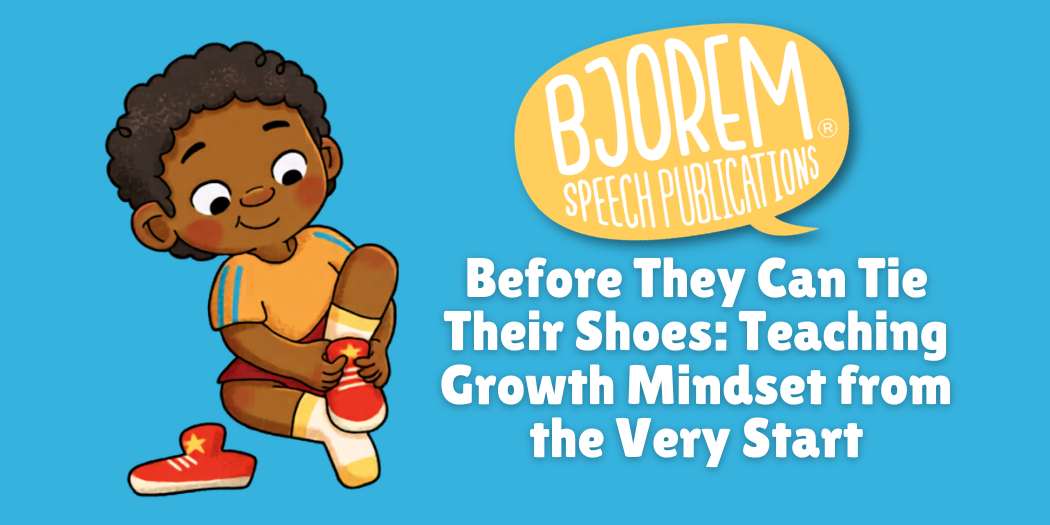
When my daughter Livi was three, she looked up at me from the floor, shoelaces tangled in her small fingers, and said, "Mom, I cannot tie my shoes, yet."
Yet.

She was three. And she had already learned that a skill she did not have today was a skill she could have tomorrow. That one little word, tucked onto the end of her sentence, told me everything I needed to know about the power of starting early, something at the heart of growth mindset for kids.
We had been working on growth mindset language since she was one year old. Not with lectures. Not with lessons. Just with words. Everyday words, chosen carefully, repeated often, folded into the ordinary moments of putting on a coat, picking up a crayon, trying a new food. By the time she was three, those words had become hers.
What Growth Mindset Actually Means
Parents and teachers often ask me, what is growth mindset for kids in the plainest possible terms, and the answer is simpler than it sounds. The phrase "growth mindset" comes from the research of Dr. Carol Dweck, a Stanford psychologist whose decades of work have reshaped how we think about learning, ability, and effort. In her foundational research, Dweck identified two ways people understand their own intelligence and skills. A fixed mindset treats abilities as set in stone. You are either smart or you are not. You are either a natural or you are not. A growth mindset, by contrast, treats abilities as something you build through effort, strategy, and persistence; a concept often simplified in growth mindset definition for kids resources.
The difference between these two ways of thinking shapes everything. It shapes how a child handles a hard math problem, how a teenager responds to a failed audition, how an adult approaches a career setback. And it begins forming in the earliest years of life, long before we think of ourselves as "teaching" anything.
Start Before You Think You Should
In my work as a speech-language pathologist, I see this truth play out every single day. Children with childhood apraxia of speech, articulation disorders, language delays, and any number of communication differences are asked to do some of the hardest cognitive and motor work of their young lives. They have to try. And try again. And try the same sound forty more times. The children who thrive in speech therapy are not always the ones with the mildest profiles. They are often the ones who have been given a framework for effort.
This is why I tell parents of one year olds, two year olds, and three year olds, start now. You do not need to wait until your child can have a philosophical conversation about learning. The words you use at eighteen months are already becoming the inner voice your child will carry into kindergarten, into middle school, into adulthood.
The Problem with "Good Job" and "I'm So Proud of You"
I want to say this with care, because every parent and educator reading this has said these phrases thousands of times, myself included. "Good job." "I'm so proud of you." They roll off the tongue. They come from a place of love.
But here is the problem. Both phrases put the locus of evaluation outside of the child. They teach children to look to us, the adults, to know whether their effort was worthwhile. They teach children to perform for our approval rather than notice their own growth. Research by Dweck and her colleagues, including a well known series of studies with Claudia Mueller published in the late 1990s, has shown that praise focused on traits or on the adult's feelings can actually undermine persistence and risk taking in children. Kids who are praised for being "smart" or "such a good girl" become more afraid of tasks that might threaten that label.
We want to raise children who notice their own effort. Who feel the satisfaction of something that was hard yesterday and is easier today. Who do not need us to tell them they did well, because they can feel it in themselves.
The Power of Yet
This brings me back to Livi and her shoes.
"Yet" is a tiny word with enormous power. Dweck has spoken and written extensively about what she calls the power of yet, including in her widely viewed TED talk on the subject. When a child says "I can't do this," the addition of "yet" reframes the entire sentence. The skill is not out of reach. It is on its way.
"I can't read this word." "I can't read this word, yet."
"I can't say my R sound." "I can't say my R sound, yet."
"I can't tie my shoes." "I can't tie my shoes, yet."
Say it with them. Add it for them. Over time, they will add it for themselves. And when they do, you will know something has clicked into place that will serve them for the rest of their lives.
The Language That Grows Brains
There is a set of phrases I come back to again and again, in my home and in my clinical work. These are the phrases I want educators, parents, therapists, and caregivers to have ready on the tip of the tongue.
"Your brain is growing."
"When you work hard, you learn new things."
"You should be proud."
"Things begin hard, but with practice they become easier."
"Your brain is a muscle."
Notice what these phrases have in common. They name what is actually happening inside the child. They describe the process, not the product. They invite the child to feel ownership of their own effort. "You should be proud" is not the same as "I am proud of you." One hands the pride to the child. The other keeps it with the adult.
And the brain as a muscle metaphor is not just poetry. It is neuroscience. When children understand that their brains physically change and strengthen with effort, a concept supported by decades of research on neuroplasticity, they engage differently with hard tasks. They stop seeing struggle as evidence that something is wrong with them. They start seeing struggle as evidence that their brain is doing exactly what it is built to do.
What to Say Instead of "Good Job" and "I'm So Proud of You"
Here is a list you can print, save, tape to the fridge, or use as a simple growth mindset worksheet for kids at home or in the classroom. Use these in place of "good job" and "I'm so proud of you." They work for toddlers, for school age children, for speech therapy sessions, for homework battles, and for any moment when you want to build a child's inner voice.
-
You worked so hard on that.
-
You kept trying, even when it was tricky.
-
Look how your brain is growing.
-
You figured that out by yourself.
-
You should be proud of that.
-
That was hard at first, and you did not give up.
-
Tell me how you did that.
-
You made a plan and it worked.
-
What a lot of effort you put in.
-
You tried a new way.
-
That is the kind of thinking that grows your brain.
-
You used a strategy there.
-
Your practice is paying off.
-
You stayed with it.
-
That was tricky and you stuck with it anyway.
-
You learned something new today.
-
How did that feel in your body when you got it?
-
You solved that problem.
-
You were brave to try something hard.
-
Notice how much easier that was than last time.
You will see that none of these ask the child to look at you for validation. Every single one points the child back to their own effort, their own thinking, their own growing brain.
Empowerment Starts Within
The goal is not to raise children who need us to tell them they are doing a good job. The goal is to raise children who know. Children who feel the pride rising up from the inside when they finally tie that shoe, read that word, produce that sound. Children who can say to themselves, at three years old or thirteen or thirty, "I cannot do this, yet."
Start young. Choose your words with intention. Step out of the evaluator role and step into the noticer role. Point out the growing, not the grade.
If you are a parent, an educator, a therapist, or any adult who shows up for children, you are already doing this work by reading this far. Your brain is growing too. This takes practice, and it begins hard, but with practice it becomes easier.
Your words become their inner voice. Choose them like they matter, because they do.