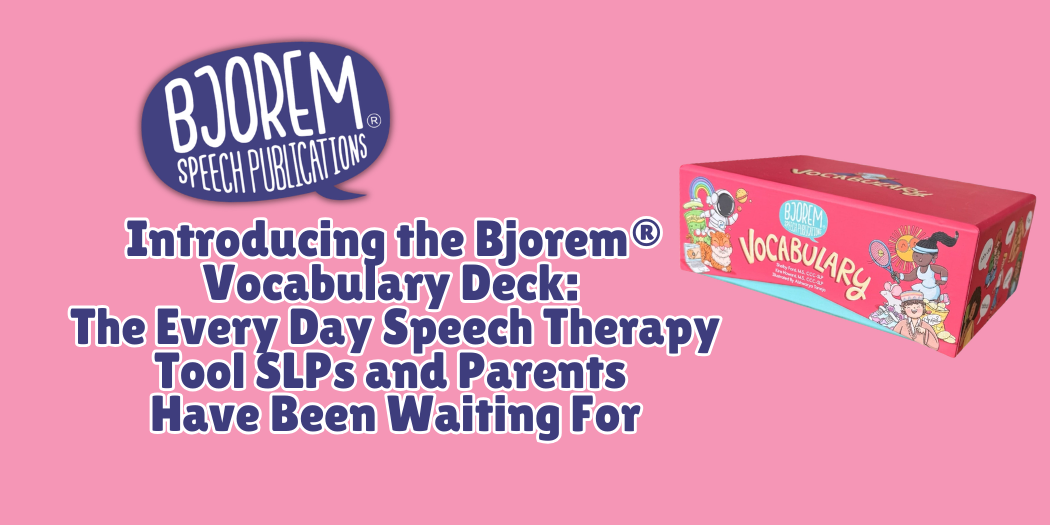
If you've been searching for a vocabulary resource that does it all — one that's research-based, flexible, engaging, and works equally well in speech therapy sessions, classrooms, and at home — the Bjorem® Vocabulary: Everyday Words for Speech and Language Deck is here, and it's a game-changer.
Whether you're a speech-language pathologist (SLP) supporting kids with language delays, a parent working on early language development at home, or an educator looking to boost vocabulary in your classroom, this deck was built with you in mind.
What Is the Bjorem® Vocabulary Deck?
The Bjorem® Vocabulary: Everyday Words for Speech and Language is a comprehensive, research-based picture card deck designed to support vocabulary development and language growth in children. Created by Shelby Ford, M.S., CCC-SLP and Kira Howard, M.S., CCC-SLP, it's organized into over 20 thematic categories — from animals, food, and community helpers to emotions, technology, and accessibility — making it easy to tailor sessions to each child's needs and interests.
But this isn't just a vocabulary deck. It's a language intervention powerhouse.
Who Is It For?
This deck is ideal for:
- SLPs working with children in early intervention, preschool, or elementary settings
- Parents supporting their child's language development at home or carrying over therapy goals
- Educators building vocabulary and language skills in classroom settings
- Children with expressive or receptive language delays, language disorders, speech sound disorders, or those who use AAC
What Makes It Different? A Research-Based Approach
Unlike generic picture card sets, the Bjorem® Vocabulary Deck is rooted in evidence-based vocabulary instruction. Research supports that children — especially those with language delays or speech and language impairments — learn vocabulary best through:
- Multiple exposures across varied contexts (Hadley et al., 2022)
- Explicit instruction with kid-friendly definitions and visuals
- Thematic, category-based organization that builds semantic networks
- Play-based, child-centered learning (Hadley et al., 2022; Yeung et al., 2019)
Every feature of this deck was designed with that science in mind.
The Many Ways to Use This Deck
One of the biggest strengths of this resource is its versatility. Here's just a snapshot of how it can be used across goals and settings:
Categories & Semantic Organization
With over 20 pre-sorted thematic categories, children can sort, identify, and classify words — a powerful strategy for building semantic networks and deepening word knowledge (Hadley et al., 2018).
Compare and Contrast
Select two or more cards and guide children to identify similarities and differences. Visual supports like Venn diagrams help make comparisons concrete and support deeper comprehension (Beck et al., 2002).
Verb Tenses
Use action cards to target present, past, and future tense. Prompts like "What happened yesterday?" and "What will happen tomorrow?" reinforce accurate tense use in meaningful context.
Instructional Verbs
Words like identify, describe, compare, and explain are essential for academic success. Research shows explicit instruction of these verbs supports independent learning and classroom participation (Lowman et al., 2018).
Parts of Speech
Use cards to sort nouns, verbs, and adjectives for building grammatical understanding that directly supports sentence formulation and reading comprehension (Cain & Oakhill, 2007; Hadley & Short, 2006).
❓ WH Questions
Targeting who, what, where, when, why, and how builds critical thinking, sentence formulation, and social communication, all foundational skills for kids with language disorders.
🔗 Word Associations
Help children understand how words relate through categories, features, and functions, a key strategy for improving word retrieval and receptive language (Beck, McKeown, & Kucan, 2013).
Pronouns & Prepositions
From he, she, they to next to, behind, in this deck supports essential grammar targets in a meaningful, contextualized way (Leonard, 2014).
Utterance Length (MLU)
Expand mean length of utterance by modeling richer sentence structures using the cards. Great for children with expressive language delays working on syntactic development.
Speech Sound Disorders
Pull cards that target a child's specific sound, create sound-loaded sentences, or work on minimal pairs — all while practicing real, functional vocabulary.
Literacy & Phonological Awareness
Use familiar vocabulary words to practice beginning sounds, syllable segmentation, blending, and rhyming critical precursors to reading and broader literacy acquisition (National Reading Panel, 2000).
Core Vocabulary Intervention
This deck also supports Core Vocabulary Intervention, a research-based approach for children with inconsistent phonological disorder (IPD). SLPs, caregivers, and educators can collaborate to select meaningful core words from the deck for targeted, individualized practice (Dodd & Iacono, 1989).
What's Inside the Deck?
Categories include (but are not limited to):
Power Words • Home • Food • School • Animals • Toys • Transportation • Instructional Verbs • Adjectives • Verbs • Emotions • Community Helpers • Places • Clothing • Sports • Weather • Technology • Outdoors • Accessibility
Each card features:
- The target vocabulary word
- Color-coding for easy organization
- Card numbering for quick reference
Why SLPs Love It
- Saves planning time — ready to use right out of the box
- Works across articulation therapy, phonological therapy, language intervention, and literacy support
- Supports differentiation across ages and ability levels
- Easy to integrate into individual sessions, small groups, classrooms, and home carryover
- Built on current, peer-reviewed research
Why Parents Love It
- Simple enough to use at home — no therapy degree required
- Supports your child's IEP vocabulary goals between sessions
- Builds real-life, functional language through play-based activities
- Helps children with language delays build confidence and communication skills
The Bottom Line
If you're looking for one resource that can do the heavy lifting across vocabulary, language, grammar, speech sounds, and literacy then this is it. The Bjorem® Vocabulary: Everyday Words for Speech and Language Deck is the kind of tool that earns a permanent spot on your therapy shelf (or your kitchen table).
It's flexible. It's evidence-based. And it meets kids exactly where they are.